Classification / Noms
Noms communs | Synonymes | Catalog of Fishes(Genre, Espèce) | ITIS | CoL | WoRMS | Cloffa
>
Characiformes (Characins) >
Acestrorhamphidae (American tetras) > Hyphessobryconinae
Etymology: Hyphessobrycon: Greek, hyphesson, -on, -on = a little smaller + Greek, bryko = to bite (Ref. 45335); wadai: Named for Luiz Wada, an ornamental fish breeder and enthusiastic aquarist, in recognition of his help in many scientific researches with fishes.
Eponymy: Luiz Wada was trained as an engineer and is now a Brazilian aquarist and breeder of ornamental fish, who runs a business called ‘Aquapet’. He was recognised for his: “…help in many scientific researches with fishes.” (Ref. 128868), visit book page.
Environnement : milieu / zone climatique / profondeur / gamme de distribution
Écologie
; eau douce benthopélagique. Tropical
South America: upper Rio Tapajós basin, Brazil.
Taille / Poids / Âge
Maturité: Lm ? range ? - ? cm
Max length : 3.5 cm SL mâle / non sexé; (Ref. 109743)
Description synthétique
Clés d'identification | Morphologie | Morphométrie
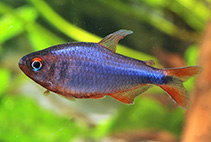
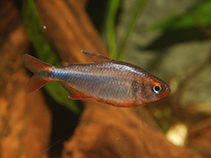
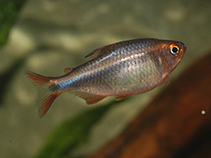
Rayons mous dorsaux (Total) : 11; Vertèbres: 32 - 33. Hyphessobrycon wadai is distinguished from all congeners by the possession of the following characters: single humeral blotch present; no distinct caudal-peduncle blotch; no well-defined dark mid-lateral stripe on body, anal fin with 16-18 branched rays; dorsal fin with nine branched rays; and pelvic fin with six branched rays (Ref. 109743).
Body shape (shape guide): fusiform / normal.
Inhabits clear water streams with moderate to rapid water currents, running over sand bottom. Feeds on filamentous algae, organic debris, unidentified insect larvae and fragments of adults of terrestrial insects and other unidentified arthropods (Ref. 109743).
Cycle de vie et comportement reproducteur
Maturité | Reproduction | Frai | Œufs | Fécondité | Larves
Marinho, M.M.F., F.C.P. Dagosta, P. Camelier and O.T. Oyakawa, 2016. A name for the "blueberry tetra", an aquarium trade popular species of Hyphessobrycon Durbin (Characiformes: Characidae), with comments on fish species descriptions lacking accurate type locality. J. Fish Biol. 89(1):510-521. (Ref. 109743)
Statut dans la liste rouge de l'IUCN (Ref. 130435: Version 2025-2 (Global))
Menace pour l'homme
Harmless
Utilisations par l'homme
Outils
Articles particuliers
Télécharger en XML
Sources Internet
Estimations basées sur des modèles
Indice de diversité phylogénétique (Réf.
82804): PD
50 = 0.5000 [Uniqueness, from 0.5 = low to 2.0 = high].
Bayesian length-weight: a=0.01202 (0.00479 - 0.03019), b=3.09 (2.90 - 3.28), in cm total length, based on LWR estimates for this Genus-body shape (Ref.
93245).
Niveau trophique (Réf.
69278): 2.9 ±0.3 se; based on size and trophs of closest relatives
Résilience (Réf.
120179): Haut, temps minimum de doublement de population inférieur à 15 mois (Preliminary K or Fecundity.).
Vulnérabilité de la pêche (Ref.
59153): Low vulnerability (10 of 100).
🛈