Classificação / Nomes
Nomes comuns | Sinónimos | Catalog of Fishes(Género, Espécies) | ITIS | CoL | WoRMS | Cloffa
>
Gobiiformes (Gobies) >
Eleotridae (Bully sleepers)
Etymology: morrisi: Named for Thomas L. Morris, discoverer and collector of this new species, renowned cave diver and speleobiologist, intrepid explorer, and respected conservationist devoted to the protection of karst habitats and their associated biotas.
Eponymy: Thomas L Morris is a “…renowned cave diver and speleobiologist, intrepid explorer, and respected conservationist devoted to the protection of karst habitats and their associated biotas”. [...] (Ref. 128868), visit book page.
Ambiente: milieu / zona climática / intervalo de profundidade / gama de distribuição
Ecologia
; Água doce demersal. Tropical
Central America: known from only a single cave system beneath Presa Miguel Alemán reservoir, northern State of Oaxaca, Mexico.
Tamanho / Peso / Idade
Maturidade: Lm ? range ? - ? cm
Max length : 3.4 cm SL macho/indeterminado; (Ref. 109339)
Descrição breve
Chaves de identificação | Morfologia | Morfometria
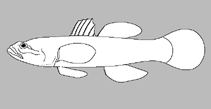
Espinhos dorsais (total) : 6 - 7; Raios dorsais moles (total) : 7 - 8; Espinhos anais: 1; Raios anais moles: 6 - 10; Vértebras: 24 - 25. Caecieleotris morrisi is distinguished from the majority of other sleepers, and all epigean forms in the Western Atlantic, by the absence of eyes and pigmentation. This species is provisionally placed in the Gobiiformes, family Eleotridae, based on a limited number of characters that it shares with other members of the family as currently recognized, e.g., having a mode of six branchiostegals, pelvic fins separated at the base, and procurrent cartilages of the caudal fin elongated posteriorly and extended over the epurals. It differs from the cave-dwelling Bostrychus microphthalmus from Sulawesi by the absence of eyes (vs. present, minute, covered by skin), complete lack of pigmentation (vs. body pale, few melanophores on dorsum), absence of scales on operculum and side of head (vs. present), lower lateral scale count (?32 vs. ?102), fewer transverse scale rows on midside of body (?6 vs. ?31), and absence of pores associated with the cephalic lateralis system (vs. present). It can be diagnosed from the blind species of Oxyeleotris from Indonesia (O. colasi) and Papua New Guinea (O. caeca) in lacking sensory pores on the head associated with the cephalic lateralis system (vs. cephalic sensory pores present, although reduced in comparison to other gobiiform fishes). It differs from the cave species of Typhleotris from Madagascar (T. madagascariensis, T. mararybe, and T. pauliani) in having the head asquamate (vs. scales extending anteriorly onto the head), squamation absent on the venter (vs. fully scaled on the belly as well as laterally below the pectoral fin), scales embedded (especially on anterior half of body) and hard to discern (vs. in prominent rows on the surface of the body and head). Cave-dwelling species of the genus Milyeringa from western Australia have elements of the first dorsal fin reduced (spines II-IV in M. veritas) to absent (M. justitia), versus V-VI in Caecieleotris morrisi; and also have 4-5 total lepidotrichia (first unsegmented) in the pelvic fin, versus six in Caecieleotris morrisi (Ref. 109339).
Body shape (shape guide): elongated.
A cave inhabitant. The cave entrance at the type locality lies at about 6.1 m deep beneath a rocky bluff along the shoreline of the lake. Immediately within the cave, the depth drops to about 27.4 m before rising to a depth close to 12.2 m where it then levels off. Flowstone (sheet-like mineral deposits typically consisting of calcite) was observed in the cave (Ref. 109339).
Ciclo de vida e comportamento de acasalamento
Maturidade | Reprodução | Desova | Ovos | Fecundidade | Larvas
Walsh, S.J. and P. Chakrabarty, 2016. A new genus and species of blind sleeper (Teleostei: Eleotridae) from Oaxaca, Mexico: First obligate cave Gobiiform in the Western hemisphere. Copeia 104(2):506-517. (Ref. 109339)
Categoria na Lista Vermelha da IUCN (Ref. 130435: Version 2025-2 (Global))
Ameaça para o homem
Harmless
Utilização humana
Pescarias: sem interesse
Ferramentas
Relatórios especiais
Descarregue XML
Fontes da internet
Estimativas baseadas em modelos
Índice de diversidade filogenética (Ref.
82804): PD
50 = 1.0000 [Uniqueness, from 0.5 = low to 2.0 = high].
Bayesian length-weight: a=0.00741 (0.00323 - 0.01701), b=3.13 (2.94 - 3.32), in cm total length, based on LWR estimates for this (Sub)family-body shape (Ref.
93245).
Nível Trófico (Ref.
69278): 3.1 ±0.5 se; based on size and trophs of closest relatives
Resiliência (Ref.
120179): Elevada, tempo mínimo de duplicação da população menor que 15 meses (Preliminary K or Fecundity.).
Vulnerabilidade da pesca (Ref.
59153): Low vulnerability (10 of 100).
🛈