>
Aulopiformes (Grinners) >
Synodontidae (Lizardfishes) > Synodontinae
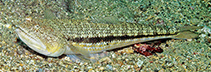
Etymology: Synodus: Greek, syn, symphysis = grown together + Greek, odous = teeth (Ref. 45335); nigrotaeniatus: Named for the diagnostic marking on the side of the body.
Entorno: milieu / zona climática / rango de profundidad / gama de distribución
Ecología
marino pelagic-neritic; rango de profundidad 10 - 30 m (Ref. 114926). Tropical
Western Pacific: Indonesia..
Tamaño / Peso / Edad
Madurez: Lm ? range ? - ? cm
Max length : 23.4 cm SL macho / no sexado; (Ref. 114926)
Descripción breve
Claves de identificación | Morfología | Morfometría
Espinas dorsales (total) : 0; Radios blandos dorsales (total) : 11 - 12; Espinas anales: 0; Radios blandos anales: 12 - 14; Vértebra: 48 - 49. This species is distinguished by the following characters: D 11-12 (usually 12); A 12-14; pectoral-fin rays 11; lateral-line scales 47-49; total vertebrae 48-49; its snout length is much greater than eye diameter, 6.0-7.1% SL or 21.6-22.6% HL; interorbital space 3.8-4.9, mean 4.4% SL; anal-fin base 18.0-19.4% SL; presence of a deep suborbital pore with prominent surrounding fimbriae extending upwards along the rear margin of the eye; rudimentary adipose fin scarcely visible without magnification; coloration of preserved and alive fish is mottled brown on back and whitish ventrally, separated by a prominent dark-brown to blackish mid-lateral stripe (Ref. 114926).
This species differs further from sageneus with the brown mottling on the back being denser in the latter and the pattern of brown bars across the lips is more prominent (Ref. 114926).
Body shape (shape guide): elongated; Cross section: oval.
This species is found on sandy bottoms and sometimes seen with only the snout and eyes
protruding above the substrate. Like other synodontids, it is a 'lie-and-wait' predator, it relies on its camouflage, hiding under the sand to wait for approaching small fishes (Ref. 114926).
Ciclo vital y comportamiento de apareamiento
Madurez | Reproducción | Puesta | Huevos | Fecundidad | Larva
Allen, G.R., M.V. Erdmann and T. Peristiwady, 2017. Synodus nigrotaeniatus, a new species of lizardfish (Aulopiformes: Synodontidae) from Indonesia. J. Ocean Sci. Found. 26:59-67. (Ref. 114926)
Situación en la Lista Roja de la UICN (Ref. 130435: Version 2025-2 (Global))
Amenaza para el ser humano
Harmless
Usos humanos
Herramientas
Informes especiales
Descargar XML
Fuentes de Internet
Estimaciones basadas en modelos
Índice de diversidad filogenética (Referencia
82804): PD
50 = 0.5000 [Uniqueness, from 0.5 = low to 2.0 = high].
Bayesian length-weight: a=0.00468 (0.00225 - 0.00972), b=3.15 (2.98 - 3.32), in cm total length, based on LWR estimates for this Genus-body shape (Ref.
93245).
Nivel trófico (Referencia
69278): 4.2 ±0.8 se; based on size and trophs of closest relatives
Resiliencia (Referencia
120179): Alto, población duplicada en un tiempo mínimo inferior a 15 meses (Preliminary K or Fecundity.).
Vulnerabilidad pesquera (Ref.
59153): Low vulnerability (18 of 100).
🛈