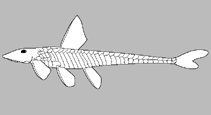
Klassificering / Namn
Populärnamn | synonymer | Catalog of Fishes(Släkte, Arter) | ITIS | CoL | WoRMS | Cloffa
>
Siluriformes (Catfishes) >
Loricariidae (Armored catfishes) > Hypoptopomatinae
Etymology: Hisonotus: Greek, isos = equal + Greek, noton = back (Ref. 45335); vespuccii: The specific name “vespuccii” comes from Italian and is in reference to Américo Vespúcio (Amerigo Vespucci in Italian), navigator and explorer to whom is attributed the discovery of the rio São Francisco in 1501 (Ref. 114934).
Eponymy: Amerigo Vespucci (1454–1512) was an Italian navigator after whom the Americas are named. [...] (Ref. 128868), visit book page.
Miljö: miljö / Klimatzon / djupintervall / distributionsområde
Ekologi
; sötvatten bottenlevande. Tropical
South America: Found the rio São Francisco and in three of its tributaries, rio das Velhas,
rio Paraopeba and rio Formoso (Ref. 114934).
Storlek / Vikt / Ålder
Könsmognad: Lm ? range ? - ? cm
Max length : 2.9 cm SL hane/ej könsbestämd; (Ref. 114934); 3.6 cm SL (female)
Kort beskrivning
Bestämningsnycklar | Morfologi | Morfometri
Taggstrålar i ryggfenan (totalt) : 2; Mjukstrålar i ryggfenan (totalt) : 7; Taggstrålar i analfenan: 0; Mjukstrålar i analfenan: 6; Ryggkotor: 27. Diagnosis: Hisonotus vespuccii differs from the congeners by having a unique coloration pattern of caudal fin with 1 black spot extending from its origin to the ventral lobe and 2 dark spots at the end of the lobe`s rays and the following combinationof character states (none is unique): odontodes forming longitudinally aligned rows (1 odontode after the other, but not necessarily forming parallel series) on head and trunk; a functional V-shaped spinelet; the presence of a single rostral plate at tip of the snout; the lack of contrasting dark geometric spots on the anterodorsal region of the body; a low caudal peduncle (depth 6–8% SL); few lateral median plates (21–23); and numerous premaxillary and dentary teeth (13–21 and 11–21, respectively) (Ref. 114934).
Body shape (shape guide): elongated.
Facultative air-breathing in the genus (Ref. 126274); Associated with marginal vegetation in the rio São Francisco and in three of its tributaries, rio das Velhas, rio Paraopeba and rio Formoso; seems to be abundant through all rio São Francisco basin (Ref. 114934).
Livscykel och parningsbeteende
Könsmognad | Reproduktion | Lek | Ägg | Fekunditet | Larver
Roxo, F.F., G.S.C. Silva and C. Oliveira, 2015. A new species of Hisonotus (Siluriformes, Loricariidae) from rio São Francisco basin, Brazil. ZooKeys 498:127-143. (Ref. 114934)
Status på IUCN:s rödlista (Ref. 130435: Version 2025-2 (Global))
Hot mot människor
Harmless
Mänskliga användningsområden
Verktyg
Särskilda rapporter
Ladda ner XML
Internet-källor
Uppskattningar baserade på modeller
Index för fylogenetisk mångfald (Ref.
82804): PD
50 = 0.5000 [Uniqueness, from 0.5 = low to 2.0 = high].
Bayesian length-weight: a=0.01175 (0.00605 - 0.02281), b=3.04 (2.87 - 3.21), in cm total length, based on LWR estimates for this species & (Sub)family-body (Ref.
93245).
Trofisk nivå (Ref.
69278): 2.3 ±0.1 se; based on size and trophs of closest relatives
Resiliens (Ref.
120179): Hög, lägsta populationsfördubblingstid mindre än 15 månader (Preliminary K or Fecundity.).
Sårbarhet i fisket (Ref.
59153): Low vulnerability (10 of 100).
🛈