Clasificación / Nombres
Nombres comunes | Sinónimos | Catalog of Fishes(Género, Especie) | ITIS | CoL | WoRMS | Cloffa
>
Siluriformes (Catfishes) >
Auchenipteridae (Driftwood catfishes) > Centromochlinae
Etymology: Tatia: Because of Mr. C. Tate Regan (Ref. 45335); britskii: Named for Dr. Heraldo Antonio Britski, who collected the type material, for his significant contributions and pioneer studies on the systematics of the catfish family Auchenipteridae.
Entorno: milieu / zona climática / rango de profundidad / gama de distribución
Ecología
; agua dulce demersal. Tropical
South America: Rio Paraná basin, Brazil.
Tamaño / Peso / Edad
Madurez: Lm ? range ? - ? cm
Max length : 3.9 cm SL macho / no sexado; (Ref. 103263)
Descripción breve
Claves de identificación | Morfología | Morfometría
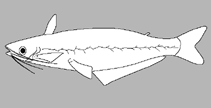
Espinas dorsales (total) : 1; Radios blandos dorsales (total) : 5; Radios blandos anales: 10; Vértebra: 32 - 33. Centromochlus britskii can be diagnosed from all members of Centromochlinae, except Gelanoglanis nanonocticolus, by the absence (vs. presence) of adipose fin. It differs from G. nanonocticolus by having two pairs (vs. one pair) of mental barbels, premaxillary tooth patches anteriorly united (vs. separated) and mouth gape straight and short (vs. large and sinuous). It is distinguished from congeners Centromochlus altae, C. existimatus, C. heckelii, C. perugiae, C. reticulatus, C. romani and C. meridionalis by having seven branched anal-fin rays (vs. 5 or 6). It further differs from C. altae, C. existimatus, C. heckelii and C. perugiae by lacking anterior nuchal plate (vs. present); from C. meridionalis and C. romani by having anterior margin of dorsal-fin spine with serrae (vs. dorsal-fin spine smooth); from C. existimatus and C. heckelii by having shorter pectoral-fin spine 20.7-22.7% of SL (vs. 29.3-41.6% of SL). Among species group that share the absence of anterior nuchal plate and seven branched anal-fin rays (i.e, C. punctatus, C. schultzi, C. macracanthus, C. bockmanni, C. simplex), the new species Centromochlus britskii differs from both C. schultzi and C. macracanthus by having smooth (vs. with denticules) posterior border of dorsalfin spine; and from C. punctatus by the morphology of male modified anal fin, specifically, the last branched anal-fin ray progressively shorter than anterior most (vs. last ray abruptly reduced, size half that of preceding one and visible only through dissection) (Ref. 103263).
Body shape (shape guide): elongated.
Found in areas with rocks and rapids near cofferdams in the main channel of the upper rio
Paraná. Stomach contents include insect larvae, including Chironomidae, and other invertebrate fragments. Attains sexual maturity at about 3.3 cm SL (Ref. 103263).
Ciclo vital y comportamiento de apareamiento
Madurez | Reproducción | Puesta | Huevos | Fecundidad | Larva
Sarmento-Soares, L.M. and J.L.O. Birindelli, 2015. A new species of the catfish genus Centromochlus (Siluriformes: Auchenipeteridae: Centromochlinae) from the upper rio Paraná basin, Brazil. Neotrop. Ichthyol. 13(1):77-86. (Ref. 103263)
Situación en la Lista Roja de la UICN (Ref. 130435: Version 2025-2 (Global))
Amenaza para el ser humano
Harmless
Usos humanos
Herramientas
Informes especiales
Descargar XML
Fuentes de Internet
Estimaciones basadas en modelos
Índice de diversidad filogenética (Referencia
82804): PD
50 = 0.5000 [Uniqueness, from 0.5 = low to 2.0 = high].
Bayesian length-weight: a=0.00490 (0.00199 - 0.01208), b=3.10 (2.88 - 3.32), in cm total length, based on LWR estimates for this (Sub)family-body shape (Ref.
93245).
Nivel trófico (Referencia
69278): 3.2 ±0.4 se; based on size and trophs of closest relatives
Resiliencia (Referencia
120179): Alto, población duplicada en un tiempo mínimo inferior a 15 meses (Preliminary K or Fecundity.).
Vulnerabilidad pesquera (Ref.
59153): Low vulnerability (10 of 100).
🛈