>
Perciformes/Serranoidei (Groupers) >
Anthiadidae (Fairy basslets or Streamer basses)
Etymology: obama: Named for Barack H. Obama, 44th President of the United States, in recognition of his efforts
to protect and preserve the natural environment, especially with his decision to expand the Papahānaumokuākea Marine National Monument several weeks after the discovery of this new species.
Eponymy: Barack Hussein Obama II (d: 1961) was 44th US President (2009–2017) and his wife Michelle LaVaughn Robinson Obama (d: 1964) was First Lady. [...] (Ref. 128868), visit book page.
Ambiente: milieu / zona climática / intervalo de profundidade / gama de distribuição
Ecologia
marinhas associadas(os) a recifes; intervalo de profundidade 90 - 92 m (Ref. 114834). Tropical
Distribuição
Territórios | Áreas FAO | Ecossistemas | Ocorrências | Mapa dos pontos | Introduções | Faunafri
East Central Pacific: Hawaii.
Tamanho / Peso / Idade
Maturidade: Lm ? range ? - ? cm
Max length : 4.3 cm SL macho/indeterminado; (Ref. 114834)
Descrição breve
Chaves de identificação | Morfologia | Morfometria
Espinhos dorsais (total) : 10; Raios dorsais moles (total) : 17; Espinhos anais: 3; Raios anais moles: 8; Vértebras: 26. This species is distinguished by the following set of characters: 4th-5th dorsal spine the
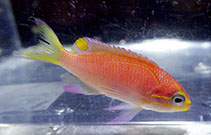
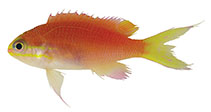
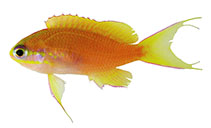
longest, D X,17; A III,8; pored lateral-line scales 33-34; head 2.9-3.0 in SL; body depth 2.8-2.9 in SL; when alive, pink or yellowish pink on head and body, slightly darker dorsally fading ventrally; snout and region immediately dorsal to eye is bright yellow, with a thin bright yellow band extending dorsally on either side of the nape; presence of a thin bright yellow horizontal stripe extending horizontally from posterior middle edge of eye posteriorly across most of operculum, continuing as a series of irregular oblong spots on midline of body from just posterior to gill opening to a point approximately one-fourth to one-half of pectoral fin; a second thin bright yellow stripe extending posteriorly from lower jaw across maxilla just ventral to eye and continuing horizontally across operculum and base of pectoral fin; the dorsal fin pink or yellowish pink with darker pink regions on membranes, and a bright magenta margin
extending from tip of first dorsal fin posteriorly on anterior half of soft dorsal fin; males with a large circular ocellate spot covering the posterior one-third of soft dorsal fin, bluish magenta on perimeter and dark red with faint yellow stripes centrally; color of anal and pelvic fins magenta or yellow; the caudal fin translucent yellow, more pale and translucent medially
and distally, with bright magenta margins extending along margins of both lobes (Ref. 114834).
Body shape (shape guide): fusiform / normal; Cross section: compressed.
This species was found living among small holes in a hard limestone bottom covered with crustose calcareous algae, in areas of apparent ancient shorelines (undercut limestone ledges adjacent to sandy bottom. Male specimens were taken by hand nets, each of which were in association with a single, presumed female (Ref. 114834). FishBase common name coined by authors.
Ciclo de vida e comportamento de acasalamento
Maturidade | Reprodução | Desova | Ovos | Fecundidade | Larvas
Pyle, R.L., B.D. Greene and R.K. Kosaki, 2016. Tosanoides obama, a new basslet (Perciformes, Percoidei, Serranidae) from deep coral reefs in the northwesern Hawaiisn Islands. ZooKeys 641:165-181. (Ref. 114834)
Categoria na Lista Vermelha da IUCN (Ref. 130435: Version 2025-2 (Global))
Ameaça para o homem
Harmless
Utilização humana
Ferramentas
Relatórios especiais
Descarregue XML
Fontes da internet
Estimativas baseadas em modelos
Índice de diversidade filogenética (Ref.
82804): PD
50 = 0.5312 [Uniqueness, from 0.5 = low to 2.0 = high].
Bayesian length-weight: a=0.01413 (0.00621 - 0.03212), b=3.00 (2.81 - 3.19), in cm total length, based on LWR estimates for this (Sub)family-body shape (Ref.
93245).
Nível Trófico (Ref.
69278): 3.2 ±0.4 se; based on size and trophs of closest relatives
Resiliência (Ref.
120179): Elevada, tempo mínimo de duplicação da população menor que 15 meses (Preliminary K or Fecundity.).
Vulnerabilidade da pesca (Ref.
59153): Low vulnerability (10 of 100).
🛈