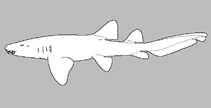
Élasmobranches (requins et raies) (sharks and rays) >
Orectolobiformes (Carpet sharks) >
Ginglymostomatidae (Nurse sharks)
Etymology: Ginglymostoma: ginglymus (Gr.), hinge; stoma (Gr.), mouth, presumably referring to how corner of mouth has a hinged appearance (See ETYFish); unami: In honor of UNAM (Universidad Nacional Autónoma de México), for the “vital role it plays in educating the people of México” (translation) (See ETYFish).
Eponymy: This is an acronym of the Universidad Nacional Autónoma de México (UNAM). (Ref. 128868), visit book page.
Environnement : milieu / zone climatique / profondeur / gamme de distribution
Écologie
marin benthopélagique. Tropical
Eastern Pacific: endemic in the area, from Mexico (Baja California including Gulf of Mexico) to Peru.
Taille / Poids / Âge
Maturité: Lm ? range ? - ? cm
Max length : 207 cm TL mâle / non sexé; (Ref. 113902)
Description synthétique
Clés d'identification | Morphologie | Morphométrie
This species is distinguished from G. cirratum by comparing several meristic characters where the distance between the prebanchial and interdorsal regions, and that of the posterior end of the second dorsal fin and the beginning of the caudal lobe, are both shorter; it also differs by the position of the insertion of the first dorsal fin with regard to the pelvic fins and in the form and number of keels on the dermal denticles and teeth morphology (Ref. 113902).
Body shape (shape guide): other (see remarks); Cross section: other (see remarks).
Cycle de vie et comportement reproducteur
Maturité | Reproduction | Frai | Œufs | Fécondité | Larves
Del Moral-Flores, L., E. Ramírez-Antonio, A. Angulo and G. Pérez-Ponce de León, 2015. Ginglymostoma unami sp. nov. (Chondrichthes: Orectolobidae: Ginglomostomidae): una especie nueva de tiburón gata del Pacífico oriental tropical. Revista Mexicana de Biodiversidad 86:48-58. (Ref. 113902)
Statut dans la liste rouge de l'IUCN (Ref. 130435: Version 2025-2 (Global))
Menace pour l'homme
Harmless
Utilisations par l'homme
Outils
Articles particuliers
Télécharger en XML
Sources Internet
Estimations basées sur des modèles
Indice de diversité phylogénétique (Réf.
82804): PD
50 = 0.8125 [Uniqueness, from 0.5 = low to 2.0 = high].
Bayesian length-weight: a=0.01000 (0.00244 - 0.04107), b=3.04 (2.81 - 3.27), in cm total length, based on all LWR estimates for this body shape (Ref.
93245).
Niveau trophique (Réf.
69278): 4.0 ±0.3 se; based on size and trophs of closest relatives
Vulnérabilité de la pêche (Ref.
59153): Very high vulnerability (90 of 100).
🛈