>
Cypriniformes (Carps) >
Cyprinidae (Minnows or carps) > Barbinae
Etymology: rifensis: The species name rifensis has been selected because the distribution range comprises the Rifian Mountains of Morocco (Ref. 107580).
Lingkungan: lingkungan / zona iklim / kisaran kedalaman / jangkauan distribusi
Ekologi
; air tawar bentopelagis. Subtropical
Africa: north Morocco, from Loukos River basin on the western Atlantic slope to the Laou River basin on the eastern Mediterranean slope (Ref. 107580).
Ukuran / Berat / umur
Kematangan: Lm ? range ? - ? cm
Max length : 22.6 cm SL jantan/; (Ref. 107580)
deskripsi pendek
Kunci identifiaksi (pengenalan) | Morfologi | Morfometrik
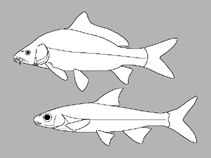
Duri punggung (Keseluruhan (total)) : 0; duri punggung lunak (Keseluruhan (total)) : 12; Duri dubur: 0; Sirip dubur lunak: 8; vertebrata, bertulang belakang: 41 - 42. Diagnosis: Luciobarbus rifensis differs from other species of Luciobarbus by the following combination of characters: 42-46 scales on the lateral line, 8.5-9.5 scales above lateral line, and 3.5-5.5 scales below lateral line; insertions of dorsal fin and ventral fin were situated similarly on the body or the insertion of the dorsal fin is lightly anterior to the ventral fin origin; last single fin ray is ossified and denticulated along its length; the denticulations at mid-height of the ray are shorter than the ray width; in adult specimens, the lower lip is well developed with retracted medial lobe revealing the dentary; the ethmoid bone is wider than long; vertebrae 41-42; and 10-15 gill rakers (Ref. 107580).
Body shape (shape guide): fusiform / normal.
This species is ubiquitous and inhabits streams and rivers with substrata ranging from sandy to stony, being absent only in small streams near the sources of rivers and in shallow waters; it is also present in reservoirs (Ref. 107580). The spawning period is variable, but usually takes place in April and May; the species migrates upstream to spawn in cold and oxygenated waters where the females excavate a nest in the gravel (Ref. 107580). It is a common species; however, its distribution area has been extensively transformed due to construction of dams, which also hamper upstream migration during the spawning period (Ref. 107580).
Siklus hidup dan perilaku kawin
Kematangan | Reproduksi, perkembang biakan | Pemijahan | telur-telur | Fekunditas | Larva
Casal-Lopez, M., S. Perea, A. Yahyaoui and I. Doadrio, 2015. Taxonomic review of the genus Luciobarbus Heckel, 1843 (Actinopterygii, Cyprinidae) from northwestern Morocco with the description of three new species. Graellsia 71(2,e27):1-24. (Ref. 107580)
Status IUCN Red List (Ref. 130435: Version 2025-2 (Global))
ancaman kepada manusia
Harmless
penggunaan manusia
Alat, peralatan
laporan khas
muat turun XML
Sumber internet
Estimasi berdasarkan model
Indeks keanekaragaman filogenetik (Acuan
82804): PD
50 = 0.5000 [Uniqueness, from 0.5 = low to 2.0 = high].
Bayesian length-weight: a=0.00617 (0.00304 - 0.01252), b=3.06 (2.89 - 3.23), in cm total length, based on LWR estimates for this Genus-body shape (Ref.
93245).
Tingkat Trofik (Acuan
69278): 2.8 ±0.3 se; based on size and trophs of closest relatives
Daya lenting (Acuan
120179): sedang, Waktu penggandaan populasi minimum 1.4 - 4.4 tahun (Preliminary K or Fecundity.).
Kerentanan Penangkapan Ikan (Ref.
59153): Low vulnerability (18 of 100).
🛈