Classification / Noms
Noms communs | Synonymes | Catalog of Fishes(Genre, Espèce) | ITIS | CoL | WoRMS | Cloffa
>
Siluriformes (Catfishes) >
Loricariidae (Armored catfishes) > Hypoptopomatinae
Etymology: Curculionichthys: Derived from the from the Latin 'curculionem' (elongated snout) and from the Greek 'ichthys' (fishes), in reference to the relatively elongated snouts of the fish species included in this genus; sagarana: The specific name sagarana is derived from two words, 'saga' of Germanic origin, meaning heroic song, and 'rana' from Tupi-Guarani language, meaning similarity. The name is in reference to the book of a Brazilian author João Guimarães Rosa published in 1946 about the history of people from Minas Gerais State living in the region of Rio das Velhas.
Environnement : milieu / zone climatique / profondeur / gamme de distribution
Écologie
; eau douce démersal. Tropical
South America: Rio das Velhas drainage, Rio São Francisco basin in Brazil.
Taille / Poids / Âge
Maturité: Lm ? range ? - ? cm
Max length : 2.3 cm SL mâle / non sexé; (Ref. 113800); 2.4 cm SL (female)
Description synthétique
Clés d'identification | Morphologie | Morphométrie
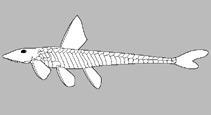
Rayons mous dorsaux (Total) : 9; Rayons mous anaux: 6; Vertèbres: 28. Curculionichthys sagarana can be distinguised from all congeners by the possession of one unpaired platelet on the dorsal portion of the caudal peduncle (vs. dorsal por¬tion of caudal peduncle without unpaired platelets). It further differs from all congeners, with the exception of Curculionichthys insperatus and C. luteofrenatus by having the caudal fin hyaline, with dark blotch limited to caudal peduncle base (vs. caudal fin hyaline, with one dark stripe extending from caudal peduncle base to the middle caudal fin rays, and for dark chromatophores irregularly distributed almost forming one or two bands); from C. insperatus, C. paresi and C. sabaji by having 15-19 premaxillary teeth (vs. 10?12 in C. insperatus; 6?10 in C. paresi and 7?12 in C. sabaji) and 12-18 dentary teeth (vs. 8?12 in C. insperatus, 4?7 in C. paresi and 7?12 in C. sabaji); from all congeners, except C. piracanjuba and C. oliveirai, by having all papillae on the lower lip randomly distributed (vs. lower lip with some papillae arranged in a medial longitudinal series extending posterior to dentaries through middle portion of lower lip); from C. oliveirai and C. coxipone by having the anterior profile of the head pointed (vs. rounded); from C. paresi by the absence of contrasting dark-brown geometric spots on the anterodorsal region of the body (vs. presence); from C. piracanjuba by having odontodes forming longitudinally aligned rows on the head and trunk (vs. odontodes not forming longitudinally aligned rows on the head and trunk); from C. sabaji, C. coxipone and C. paresi by having the cleithrum completely covered with odontodes (vs. the cleithrum with an area free of odontodes); from C. insperatus by having small, inconspicuous odontodes forming rows on the head and trunk (vs. large, conspicuous odontodes forming rows on the head and the trunk); from C. oliveirai by having 6?9 lateral abdomen plates (vs. 4?5); from C. piracanjuba by not having hypertrophied odontodes on the snout tip (vs. hypertrophied odontodes on the snout tip). In addition, Curculionichthys sagarana can be diagnosed by the following characters: deeper caudal peduncle (8.4-9.6 % of SL, vs. 10.8-12.5% of SL in C. oliveirai; 10.2-11.3% in C. paresi); greater head length (34.8-40.5% of SL, vs. 28.8-33.3% of SL in C. luteofrenatus; 27.9-32.2% of SL in C. piracanjuba); shorter snout (46.3-52.4% of HL, vs. 67.0-75.3% of HL in C. luteofrenatus; 67.7-72.7% of HL in C. piracanjuba); shorter interorbital width (27.4-33.6% of SL, vs. 33.3-45.4% of HL in C. luteofrenatus; 36.7-40.9% of HL in C. piracanjuba; 33.8-37.8% of HL in C. coxipone); deeper head (41.2-49.1% of HL, vs. 51.6-59.2% of HL in C. oliveirai); shorter dorsal-spine (19.9-24.4% of SL, vs. 25.2-27.0% of SL in C. paresi); and shorter pectoral-spine (21.5-25.2% of SL, vs. 27.0-30.1% of SL in C. paresi) (Ref. 113800).
Body shape (shape guide): elongated.
Cycle de vie et comportement reproducteur
Maturité | Reproduction | Frai | Œufs | Fécondité | Larves
Roxo, F.F., G.S.C. Silva, L.E. Ochoa and C. Oliveira, 2015. Description of a new genus and three new species of Otothyrinae (Siluriformes, Loricariidae). Zookeys 534:103-134. (Ref. 113800)
Statut dans la liste rouge de l'IUCN (Ref. 130435: Version 2025-2 (Global))
Menace pour l'homme
Harmless
Utilisations par l'homme
Pêcheries: sans intérêt
Outils
Articles particuliers
Télécharger en XML
Sources Internet
Estimations basées sur des modèles
Indice de diversité phylogénétique (Réf.
82804): PD
50 = 0.5001 [Uniqueness, from 0.5 = low to 2.0 = high].
Bayesian length-weight: a=0.00977 (0.00434 - 0.02202), b=3.06 (2.87 - 3.25), in cm total length, based on LWR estimates for this (Sub)family-body shape (Ref.
93245).
Niveau trophique (Réf.
69278): 2.6 ±0.1 se; based on size and trophs of closest relatives
Résilience (Réf.
120179): Haut, temps minimum de doublement de population inférieur à 15 mois (Preliminary K or Fecundity.).
Vulnérabilité de la pêche (Ref.
59153): Low vulnerability (10 of 100).
🛈