Elasmobranchi (squali e razze) (sharks and rays) >
Squaliformes (Sleeper and dogfish sharks) >
Etmopteridae (Lantern sharks)
Etymology: Etmopterus: Greek, ethmos, -ou = sieve or ethmoides bone + Greek, pteron = wing, fin (Ref. 45335).
Eponymy: The fallen angel Lucifer, of the Judeo-Christian tradition, is referred to in the fourteenth chapter of the Biblical book of Isaiah: ‘How art thou fallen from heaven, O Lucifer, son of the morning! How art thou cut down to the ground, which didst we [...] (Ref. 128868), visit book page.
More on authors: Jordan & Snyder.
Taxonomic Remarks
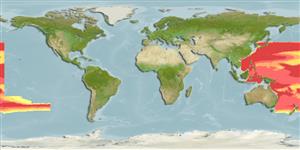
Research shows that this species is restricted to northwestern Pacific ; Austral-Indonesian records are considered to represent two or three undescribed species (see Ref. 87957); distribution will be resolved (linked to correct species) when publications are received.
Ambiente: milieu / zona climatica / distribuzione batimetrica / gamma di distribuzione
Ecologia
marino pelagic-oceanic; distribuzione batimetrica 150 - 1357 m (Ref. 106604). Deep-water; 40°N - 48°S
Western Pacific: Japan to Philippines.
Lunghezza alla prima maturità / Dimensione / Peso / Età
Maturità: Lm ?, range 34 - ? cm
Max length : 55.0 cm TL maschio/sesso non determinato; (Ref. 122636); peso massimo pubblicato: 775.00 g (Ref. 122636)
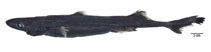
Spine dorsali (totale) : 2; Spine anali: 0. Dark grey (Ref. 6577) or brown dorsally, black ventrally, with a distinct black streak above and behind pelvic fins; fins lighter; belly luminous (Ref. 26346). Small and slender with a moderately elongate caudal peduncle and with flank denticles mostly arranged in regular rows. The base of the pelvic flank marking is under the second dorsal-fin spine, the anterior branch is usually longer than the posterior branch, and the caudal marking is considerably longer than the precaudal marking (Ref. 6871).
Body shape (shape guide): elongated.
Found on the outer continental and insular shelves and upper slopes (Ref. 247). Its luminescent belly may attract prey (Ref. 26346), which consists mainly of squid (reported to bite squid bigger than itself), small bony fishes, and shrimps (Ref. 247). Often caught in large schools which may suggest that the luminescence may also be used to keep the group together in the dark deep ocean (Ref. 26346). Ovoviviparous (Ref. 205), size at birth about 15 cm (Ref. 6871).
Ciclo vitale e comportamento di accoppiamento
Maturità | Riproduzione | Deposizione | Uova | Fecondità | Larve
Presumably ovoviviparous (Ref. 6871). Size at birth about 15 cm (Ref. 6871). Distinct pairing with embrace (Ref. 205).
Compagno, L.J.V., 1984. FAO Species Catalogue. Vol. 4. Sharks of the world. An annotated and illustrated catalogue of shark species known to date. Part 1 - Hexanchiformes to Lamniformes. FAO Fish. Synop. 125(4/1):1-249. Rome, FAO. (Ref. 247)
Stato della Lista Rossa IUCN (Ref. 130435: Version 2025-2 (Global))
Minaccia per l'uomo
Harmless
Usi umani
Pesca: di nessun interesse
Strumenti
Rapporti speciali
Scarica XML
Fonti Internet
Stime basate su modelli
Temperatura preferita (Fonte Biblio.
123201): 6.7 - 14.6, mean 9.6 °C (based on 350 cells).
Indice di diversità filogenetica (Fonte Biblio.
82804): PD
50 = 0.5000 [Uniqueness, from 0.5 = low to 2.0 = high].
Bayesian length-weight: a=0.00245 (0.00162 - 0.00372), b=3.07 (2.94 - 3.20), in cm total length, based on LWR estimates for this species & Genus-body shape (Ref.
93245).
Livello trofico (Fonte Biblio.
69278): 4.2 ±0.3 se; based on diet studies.
Resilienza (Fonte Biblio.
120179): Molto basso, tempo minimo di raddoppiamento della popolazione più di 14 anni (Fec assumed to be <10).
Vulnerabilità della pesca (Ref.
59153): Moderate vulnerability (42 of 100).
🛈
Nutrienti (Ref.
124155): Calcium = 8.37 [1.63, 45.94] mg/100g; Iron = 0.348 [0.084, 1.304] mg/100g; Protein = 19.1 [16.5, 21.3] %; Omega3 = 0.331 [0.114, 1.053] g/100g; Selenium = 10.4 [2.6, 35.8] μg/100g; VitaminA = 31.4 [5.4, 200.3] μg/100g; Zinc = 0.478 [0.223, 0.979] mg/100g (wet weight);