Classificação / Nomes
Nomes comuns | Sinónimos | Catalog of Fishes(Género, Espécies) | ITIS | CoL | WoRMS | Cloffa
>
Siluriformes (Catfishes) >
Loricariidae (Armored catfishes) > Hypostominae
Etymology: Chaetostoma: Greek, chaite = hair + Greek, stoma = mouth (Ref. 45335); trimaculineum: Derivedfrom the Latin prefix tri, meaning three, and nouns macula, meaning spot, and linea, meaning line, in reference to the three distinctive rows of spots along the flanks of this species.
Ambiente: milieu / zona climática / intervalo de profundidade / gama de distribuição
Ecologia
; Água doce demersal. Tropical
South America: upper Santiago and middle Marañon river drainages in eastern Ecuador and northern Peru.
Tamanho / Peso / Idade
Maturidade: Lm ? range ? - ? cm
Max length : 16.0 cm SL macho/indeterminado; (Ref. 104727)
Descrição breve
Chaves de identificação | Morfologia | Morfometria
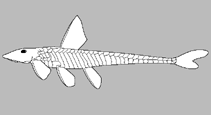
Chaetostoma trimaculineum is distinguished from all other congeners from Amazon Basin except C. anale by having three to four linear rows of distinct, round, naris-sized black spots on the median, mid-dorsal, and dorsal plate series of the trunk (vs. absence of black spots, larger than orbit, or also present on mid-ventral plate series). It also differs from all other Amazon Basin species except C. anale, C. daidalmatos, C. dermorhynchum, middle Ucayali populations of C. lineopunctatum (including type locality), C. stroumpoulos, and C. vagum by having distinct round black spots half naris diameter spaced less than one spot width apart on head (vs. absence of spots on head or white); from C. anale, C. carrioni, C. lexa, C. marmorescens, C. stroumpoulos, and C. vagum by having four branched rays on anal fin (vs. anal fin absent or with most frequently three or less or five branched rays); from C. branickii/taczanowskii, C. carrioni, C. lexa, C. loborhynchos, C. marmorescens, and C. microps by having a supraoccipital excrescence (vs. absence of excrescence); from C. changae, C. jegui, C. lexa, C. marmorescens, and C. microps by having eight branched dorsal-fin rays (vs. most frequently nine or sometimes ten); from C. anale, C. carrioni, C. daidalmatos, C. lexa, and C. microps by having more teeth per premaxillary ramus (an average of
112632, vs. typically, 80); from C. anale, C. carrioni, C. lexa, C. marmorescens, and C. microps by having more teeth per mandible (an average of 156645, vs. typically, 111); from C. breve, C. lineopunctatum, and C. microps by having lesser head depth (23.060.3% SL, vs. 23.3); from C. loborhynchos and C. marmorescens by having lesser cleithral width (32.760.8% SL, vs. 33.5); and from C. branickii/taczanowskii and C. lexa by having four or five evertible cheek odontodes (vs. six or more). Chaetostoma trimaculineum mostly resembles C. anale but can be distinguished by the tooth and anal-fin branched ray counts, by the absence of spots from most or all of the compound pterotic (vs. spots covering the pterotic), by having generally straighter rows of spots along the body, and by lacking spots from the mid-ventral plate series (vs. spots often present on at least some mid-ventral plates) (Ref. 104727).
Body shape (shape guide): elongated.
Facultative air-breathing in the genus (Ref. 126274)
Ciclo de vida e comportamento de acasalamento
Maturidade | Reprodução | Desova | Ovos | Fecundidade | Larvas
Lujan, N.K., V. Meza-Vargas, V. Astudillo-Clavijo, R. Barriga-Salazar and H. López-Fernández, 2015. A multilocus molecular phylogeny for Chaetostoma Clade genera and species with a review of Chaetostoma (Siluriformes: Loricariidae) from the Central Andes. Copeia 103(3):664-701. (Ref. 104727)
Categoria na Lista Vermelha da IUCN (Ref. 130435: Version 2025-2 (Global))
Ameaça para o homem
Harmless
Utilização humana
Ferramentas
Relatórios especiais
Descarregue XML
Fontes da internet
Estimativas baseadas em modelos
Índice de diversidade filogenética (Ref.
82804): PD
50 = 0.5000 [Uniqueness, from 0.5 = low to 2.0 = high].
Bayesian length-weight: a=0.01660 (0.00737 - 0.03739), b=2.95 (2.77 - 3.13), in cm total length, based on LWR estimates for this Genus-body shape (Ref.
93245).
Resiliência (Ref.
120179): Médio, tempo mínimo de duplicação da população 1,4 - 4,4 anos (Preliminary K or Fecundity.).
Vulnerabilidade da pesca (Ref.
59153): Low vulnerability (10 of 100).
🛈