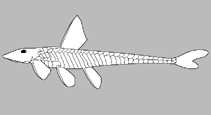
Classification / Noms
Noms communs | Synonymes | Catalog of Fishes(Genre, Espèce) | ITIS | CoL | WoRMS | Cloffa
>
Siluriformes (Catfishes) >
Loricariidae (Armored catfishes) > Hypostominae
Etymology: Chaetostoma: Greek, chaite = hair + Greek, stoma = mouth (Ref. 45335); bifurcum: From the Latin adjective bifurcum, meaning two-pronged, in reference to the two evertible cheek odontodes characteristic of this species.
Environnement : milieu / zone climatique / profondeur / gamme de distribution
Écologie
; eau douce démersal. Tropical
South America: Pacific Coast drainages of western Ecuador and northwestern Peru, including (from north to south) the Esmeraldas, Guayas, Santa Rosa, and Tumbes river drainages.
Taille / Poids / Âge
Maturité: Lm ? range ? - ? cm
Max length : 14.0 cm SL mâle / non sexé; (Ref. 104727)
Description synthétique
Clés d'identification | Morphologie | Morphométrie
Chaetostoma bifurcum is distinguished from all congeners along along the Pacific Coast of South America except C. palmeri and C. paucispinis by having only 1 or 2 evertible cheek odontodes (vs. 3-6); from C. niveum, C. palmeri, C. patiae, and C. paucispinis by having most frequently 4 branched rays on anal fin (vs. 5); from C. palmeri and C. paucispinis by having body with black, indistinct, vertically elongate, irregularly broken or complete bars K to O width of orbit in living adults (vs. body uniform or with transverse cross-bars wider than two times orbit centered on dorsal midline); and from C. paucispinis by having 8 branched rays on dorsal fin (vs. 9) (Ref. 104727).
Body shape (shape guide): elongated.
Facultative air-breathing in the genus (Ref. 126274); Found in piedmont elevations approximately 100 to 650 masl (Ref. 104727).
Cycle de vie et comportement reproducteur
Maturité | Reproduction | Frai | Œufs | Fécondité | Larves
Lujan, N.K., V. Meza-Vargas, V. Astudillo-Clavijo, R. Barriga-Salazar and H. López-Fernández, 2015. A multilocus molecular phylogeny for Chaetostoma Clade genera and species with a review of Chaetostoma (Siluriformes: Loricariidae) from the Central Andes. Copeia 103(3):664-701. (Ref. 104727)
Statut dans la liste rouge de l'IUCN (Ref. 130435: Version 2025-2 (Global))
Menace pour l'homme
Harmless
Utilisations par l'homme
Outils
Articles particuliers
Télécharger en XML
Sources Internet
Estimations basées sur des modèles
Indice de diversité phylogénétique (Réf.
82804): PD
50 = 0.5000 [Uniqueness, from 0.5 = low to 2.0 = high].
Bayesian length-weight: a=0.01660 (0.00737 - 0.03739), b=2.95 (2.77 - 3.13), in cm total length, based on LWR estimates for this Genus-body shape (Ref.
93245).
Résilience (Réf.
120179): Milieu, temps minimum de doublement de population : 1,4 à 4,4 années (Preliminary K or Fecundity.).
Vulnérabilité de la pêche (Ref.
59153): Low vulnerability (10 of 100).
🛈