>
Eupercaria/misc (Various families in series Eupercaria) >
Sparidae (Porgies)
Etymology: Polysteganus: Greek, polys = a lot of + Greek, stego, stege = covered (Ref. 45335); cerasinus: Named for its cherry blossom colour.
Ambiente: milieu / zona climatica / distribuzione batimetrica / gamma di distribuzione
Ecologia
marino associati a barriera corallina; distribuzione batimetrica ? - 127 m (Ref. 106993). Tropical
Western Indian Ocean: Mascarene Plateau, Saya de Malha Bank. High Seas only.
Dimensione / Peso / Età
Maturità: Lm ? range ? - ? cm
Max length : 13.4 cm SL maschio/sesso non determinato; (Ref. 106993)
Breve descrizione
Chiavi di identificazione | Morfologia | Morfometria
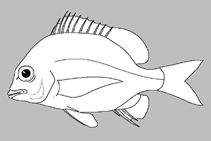
Spine dorsali (totale) : 12; Raggi dorsali molli (totale) : 10; Spine anali: 3; Raggi anali molli: 8. This species is distinguished from its congeners by the following set of characters: scale rows above lateral line 6½ and between 5th dorsal-fin spine base and lateral line 4½; pored lateral-line scales 49; suborbital depth is clearly less than orbit diameter (OD), 60% OD; without lines of blue spots on body; dorsal-fin rays are reddish pink but yellowish membranes of both pinkish dorsal-fin and caudal-fin fin lobes; absence of blue iridescence on body but bright whitish iridescence on each body scale of lateral side of bright pinkish body; deep body 43% SL; without bony bulge before and above eye; pinkish upper and lower caudal-fin as well as rear pinkish margin of the caudal fin with yellowish hyaline membrane of most of caudal fin with no whitish upper and lower margins; rear margin of membrane of branchiostegal rays is yellow, with yellow hue on some body scales just above upper pectoral-fin base; caudal fin is moderately forked (Ref. 106993).
Body shape (shape guide): short and / or deep; Cross section: compressed.
This species is more likely to inhabit the somewhat shallower coastal waters around its area of occurrence than other Polysteganus which have been trawled deeper than 200 m (Ref. 106993).
Ciclo vitale e comportamento di accoppiamento
Maturità | Riproduzione | Deposizione | Uova | Fecondità | Larve
Iwatsuki, Y. and P.C. Heemstra, 2015. Redescriptions of Polysteganus coeruleopunctatus (Klunzinger 1870) and P. lineopunctatus (Boulenger 1903), with two new species from Western Indian Ocean. Zootaxa 4059(1):133-150. (Ref. 106993)
Stato della Lista Rossa IUCN (Ref. 130435: Version 2025-2 (Global))
Minaccia per l'uomo
Harmless
Usi umani
Strumenti
Rapporti speciali
Scarica XML
Fonti Internet
Stime basate su modelli
Indice di diversità filogenetica (Fonte Biblio.
82804): PD
50 = 0.5039 [Uniqueness, from 0.5 = low to 2.0 = high].
Bayesian length-weight: a=0.01995 (0.00935 - 0.04259), b=2.97 (2.80 - 3.14), in cm total length, based on LWR estimates for this (Sub)family-body shape (Ref.
93245).
Livello trofico (Fonte Biblio.
69278): 3.7 ±0.6 se; based on size and trophs of closest relatives
Resilienza (Fonte Biblio.
120179): Alto, tempo minimo di raddoppiamento della popolazione meno di 15 mesi (Preliminary K or Fecundity.).
Vulnerabilità della pesca (Ref.
59153): Low vulnerability (10 of 100).
🛈