Elasmobranchi (squali e razze) (sharks and rays) >
Squaliformes (Sleeper and dogfish sharks) >
Etmopteridae (Lantern sharks)
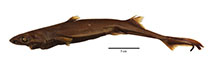
Etymology: Etmopterus: Greek, ethmos, -ou = sieve or ethmoides bone + Greek, pteron = wing, fin (Ref. 45335); alphus: Name from Latin 'alphus'; referring to the characteristic white spot on the cheeks of this species.
Ambiente: milieu / zona climatica / distribuzione batimetrica / gamma di distribuzione
Ecologia
marino pelagic-oceanic; distribuzione batimetrica 472 - 792 m (Ref. 112348). Subtropical; 18°S - 34°S, 37°E - 45°E
Western Indian Ocean: Mozambique.
Dimensione / Peso / Età
Maturità: Lm ? range ? - ? cm
Max length : 33.6 cm TL maschio/sesso non determinato; (Ref. 112348); 39.0 cm TL (female)
Breve descrizione
Chiavi di identificazione | Morfologia | Morfometria
Vertebre: 84 - 90. This relatively small, slender species of linear-denticled Etmopterus can be separated from its closest congeners within the E. lucifer clade by a combination of characteristics: length of its anterior flank markings being much shorter than its posterior branch; black flank markings sharply demarcated by surrounding lighter to whitish lateral markings; prominent white spot on each cheek; a single white stripe extending the length of the midback; 2 parallel rows of prominent dark pores extending between pectoral and pelvic fins; its closest geographic congener E. sculptus has its anterior branch longer than its posterior branch, with a thinner posterior flank marking, 0.2-0.4% (vs. 0.6-0.9% TL in E. alphus), a higher spiral valve count 8-9 (vs. 5-7 in E. alphus); it differs from its closest morphological congener, the Australasian E. molleri by its shorter anterior (6.0-10.6% vs. 8.0-11.5% TL) and posterior (9.3-12.7% vs. 11.0-15.4% TL) flank-marking branches, biogeography and genetics (Ref. 112348).
Body shape (shape guide): fusiform / normal; Cross section: oval.
Ciclo vitale e comportamento di accoppiamento
Maturità | Riproduzione | Deposizione | Uova | Fecondità | Larve
Ebert, D.A., N. Straube, R.W. Leslie and S. Weigmann, 2016. Etmopterus alphus n. sp.: a new lanternshark (Squaliformes: Etmopteridae) from the southwestern Indian Ocean. Afr. J. Mar. Sci. 38(3):329-340. (Ref. 112348)
Stato della Lista Rossa IUCN (Ref. 130435: Version 2025-2 (Global))
Minaccia per l'uomo
Harmless
Usi umani
Pesca: di nessun interesse
Strumenti
Rapporti speciali
Scarica XML
Fonti Internet
Stime basate su modelli
Indice di diversità filogenetica (Fonte Biblio.
82804): PD
50 = 0.5000 [Uniqueness, from 0.5 = low to 2.0 = high].
Bayesian length-weight: a=0.01122 (0.00514 - 0.02450), b=3.04 (2.87 - 3.21), in cm total length, based on all LWR estimates for this body shape (Ref.
93245).
Livello trofico (Fonte Biblio.
69278): 4.1 ±0.5 se; based on size and trophs of closest relatives
Resilienza (Fonte Biblio.
120179): Basso, tempo minimo di raddoppiamento della popolazione 4.5 - 14 anni (Preliminary low fecundity).
Vulnerabilità della pesca (Ref.
59153): Low to moderate vulnerability (29 of 100).
🛈