Elasmobranchii (tubarões e raias) (sharks and rays) >
Torpediniformes (Electric rays) >
Torpedinidae (Electric rays)
Etymology: cowleyi: The species is named after Paul Cowley, South African Institute for Aquatic Biodiversity, in recognition of his contributions to the study of fishes in southern Africa (Ref. 100734).
Eponymy: Dr Paul D Cowley is principle scientist at the South African Institute for Aquatic Biodiversity (since 2000) and honorary professor and Research Associate at the Department of Ichthyology and Fisheries Science at Rhodes University. [...] (Ref. 128868), visit book page.
Ambiente: milieu / zona climática / intervalo de profundidade / gama de distribuição
Ecologia
marinhas bentopelágico; intervalo de profundidade 110 - 457 m (Ref. 100734). Temperate; 22°S - 37°S, 12°E - 28°E (Ref. 114953)
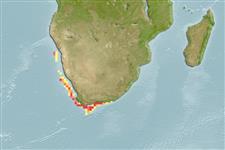
Southeast Atlantic: around southern Africa, from Walvis Bay, Namibia to Algoa Bay, Eastern Cape, South Africa (Ref. 100734).
Comprimento na primeira maturidade / Tamanho / Peso / Idade
Maturidade: Lm ?, range 101 - ? cm
Max length : 68.0 cm TL macho/indeterminado; (Ref. 100734); 113.3 cm TL (female)
Descrição breve
Chaves de identificação | Morfologia | Morfometria
Diagnosis: This medium-sized torpedo ray species has a uniform shiny black to dark gray live dorsal color, and is distinguished from its most similar congeners Tetronarce nobiliana and T. puelcha by the following combination of characters: shorter spiracular length, 1.5-1.6% of total length vs. 2.6-2.8% in T. nobiliana and 2.4-3.1% in T. puelcha; a proportionally greater head length as measured between snout margin and fifth gill openings, 30.5-31.2% of total length vs. 24.7-25.8% in T. nobiliana and 26.8% in adult male T. puelcha; and a proportionally greater preoral snout length, 8.9-9.3% of total length vs. 7.4-7.6% in T. nobiliana and 6.5-8.4% in T. puelcha (Ref. 100734). It is further distinguished from T. nobiliana by its more circular anterior disc shape vs. relatively straight; fewer tooth rows, 32/28 vs. 38/38 in T. nobiliana from the North Sea and up to 53/52 in T. nobiliana from the Mediterranean; greater mouth width, 1.5-1.7 times as great as interorbital width vs. 0.5-0.6 times interorbital width; smaller distance between second dorsal and caudal fins, 3.5-4.9% vs. 6.6-6.8%; and greater clasper length in mature individuals, extending nearly to lower caudal fin origin vs. clasper extends only two-thirds the distance between second dorsal and caudal fins (Ref. 100734).
Cross section: flattened.
This species is mostly found along the outer continental shelf and upper slope near the bottom, but also well off it and at bottom depths of 110-457 m (Ref. 100734). Females mature by at least 100.5 cm total length and males at about 58.2 cm total length (Ref. 100734); born before 19 cm TL (Ref. 114953). Neonates reported to have been collected during pelagic plankton tows on the edge of the outer continental shelf southwest of Cape Town (Ref. 100734). The limited capture of this electric ray in bottom trawls is suspected to be not indicative of its abundance in the area, but rather by its ability to move well off the bottom while foraging for fish and other large prey; diet consists mainly of large bottom and pelagic bony fishes and small sharks (Ref. 100734).
Ciclo de vida e comportamento de acasalamento
Maturidade | Reprodução | Desova | Ovos | Fecundidade | Larvas
Ebert, D.A., D.L. Haas and M.R. De Carvalho, 2015. Tetronarce cowleyi, sp. nov., a new species of electric ray from southern Africa (Chondrichthyes: Torpediniformes: Torpedinidae). Zootaxa 3936(2):237-250. (Ref. 100734)
Categoria na Lista Vermelha da IUCN (Ref. 130435: Version 2025-2 (Global))
Ameaça para o homem
Harmless
Utilização humana
Ferramentas
Relatórios especiais
Descarregue XML
Fontes da internet
Estimativas baseadas em modelos
Índice de diversidade filogenética (Ref.
82804): PD
50 = 0.5001 [Uniqueness, from 0.5 = low to 2.0 = high].
Bayesian length-weight: a=0.01479 (0.00678 - 0.03229), b=2.97 (2.78 - 3.16), in cm total length, based on LWR estimates for this (Sub)family-body shape (Ref.
93245).
Nível Trófico (Ref.
69278): 4.4 ±0.6 se; based on size and trophs of closest relatives
Resiliência (Ref.
120179): Muito baixo, tempo mínimo de duplicação da população maior que 14 anos (Preliminary K or Fecundity.).
Vulnerabilidade da pesca (Ref.
59153): High to very high vulnerability (68 of 100).
🛈