Elasmobranchi (squali e razze) (sharks and rays) >
Myliobatiformes (Stingrays) >
Dasyatidae (Stingrays) > Dasyatinae
Etymology: Telatrygon: Name from Latin 'telum' for javelin, spear, arrow, dart and Greek 'trygon' for stingray; referring to the long, narrowly pointed snout possessed by all members of the genus; biasa: Name from the Indonesian and Malaysian word ‘biasa’ meaning ‘ordinary, common or normal’; referring to the frequent occurrence of this species in local fish markets; noun in apposition.
Ambiente: milieu / zona climatica / distribuzione batimetrica / gamma di distribuzione
Ecologia
marino pelagic-neritic; distribuzione batimetrica ? - 40 m (Ref. 110363). Tropical
Western North Pacific, including Indonesia and Malaysian Borneo; reported from the Philippines but no current specimens reported.
Lunghezza alla prima maturità / Dimensione / Peso / Età
Maturità: Lm 18.5, range 18 - 19.3 cm
Max length : 28.7 cm WD maschio/sesso non determinato; (Ref. 110363)
Breve descrizione
Chiavi di identificazione | Morfologia | Morfometria
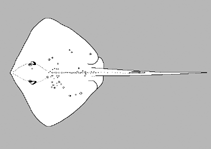
This species is distinguished by the following set of characters: relatively short snout, length of preorbital 28-29% DW, preoral 27-28% DW and prenasal 23-25% DW; relatively short disc, its length 97-105% DW; the preoral length is 1.5-1.6 times width between the first gill openings; small eyes, orbit length 5-7% DW; 107-114 pectoral-fin radials; total vertebral centra (excluding the first synarcual) 85-94 (Ref. 110363).
Body shape (shape guide): other (see remarks); Cross section: flattened.
Demersal on the continental and insular shelves of up to approximately 40 m depth. Birth size is 7.0 - 9.0 cm WD (Ref. 110363).
Ciclo vitale e comportamento di accoppiamento
Maturità | Riproduzione | Deposizione | Uova | Fecondità | Larve
Last, P.R., W.T. White and G. Naylor, 2016. Three new stingrays (Myliobatiformes: Dasyatidae) from the Indo-West Pacific. Zootaxa 4147(4):377-402. (Ref. 110363)
Stato della Lista Rossa IUCN (Ref. 130435: Version 2025-2 (Global))
Minaccia per l'uomo
Harmless
Usi umani
Strumenti
Rapporti speciali
Scarica XML
Fonti Internet
Stime basate su modelli
Indice di diversità filogenetica (Fonte Biblio.
82804): PD
50 = 0.5625 [Uniqueness, from 0.5 = low to 2.0 = high].
Bayesian length-weight: a=0.00447 (0.00189 - 0.01058), b=3.12 (2.92 - 3.32), in cm total length, based on LWR estimates for this (Sub)family-body shape (Ref.
93245).
Livello trofico (Fonte Biblio.
69278): 3.8 ±0.5 se; based on size and trophs of closest relatives
Vulnerabilità della pesca (Ref.
59153): Very high vulnerability (90 of 100).
🛈