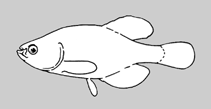
Klassifizierung / Names
Namen | Synonyme | Catalog of Fishes(Gattung, Arten) | ITIS | CoL | WoRMS | Cloffa
>
Cyprinodontiformes (Rivulines, killifishes and live bearers) >
Rivulidae (Rivulines) > Cynolebiinae
Etymology: shibattai: Named for Oscar Akio Shibatta, for his contribution to South American ichthyology.
Eponymy: Dr Oscar Akio Shibatta is a professor at the Departamento de Biologia Animal e Vegetal, Centro de Ciências Biológicas, at the Universidade Estadual de Londrina, Brazil. [...] (Ref. 128868), visit book page.
Umwelt: Milieu / Klimazone / Tiefenbereich / Verbreitungsgebiet
Ökologie
; süßwasser benthopelagisch; pH range: 6.5 - ?. Tropical; 26°C - 30°C (Ref. 94796)
South America: Rio São Francisco basin in Bahia state, Brazil.
Größe / Gewicht / Alter
Geschlechtsreife: Lm ? range ? - ? cm
Max length : 3.4 cm SL Männchen/unbestimmt; (Ref. 94796); 2.6 cm SL (female)
Kurzbeschreibung
Bestimmungsschlüssel | Morphologie | Morphometrie
Rückenflossenweichstrahlen (insgesamt) : 13 - 21; Afterflossenweichstrahlen: 16 - 19; Wirbelzahl: 25 - 26.
Body shape (shape guide): fusiform / normal.
The type locality is a typical annual pool with substrate composed of clay and sand with
slightly turbid water, and dense aquatic vegetation consisting of large stands of Utricularia sp. and Nymphaea sp. Occurs sympatrically with two other annual rivulids (Cynolebias sp. and Hypsolebias sp.) The pool has average depth of 80 cm, with the deepest portions about 1.2 m deep, slighty acidic water (pH 6.5), a low electric conductivity (22 μS/cm)., and water temperature of about 30°C at the surface and approximately 26°C at the deepest portion and shaded banks (Ref. 94796).
Lebenszyklus und Paarungsverhalten
Geschlechtsreife | Fortpflanzung | Ablaichen | Eier | Fruchtbarkeit | Larven
Nielsen, D.T.B., M. Martins, L.M. de Araujo and Suzart, R. dos Reis, 2014. Hypsolebias shibattai, a new species of annual fish (Cyprinodontiformes: Rivulidae) from the rio São Francisco northern Brazil. aqua, Int. J. Ichthyol. 20(1):27-34. (Ref. 94796)
IUCN Rote Liste Status (Ref. 130435: Version 2025-2 (Global))
Bedrohung für Menschen
Harmless
Nutzung durch Menschen
Fischereien: nicht kommerziell
Tools
Zusatzinformationen
Download XML
Internet Quellen
Schätzungen auf der Grundlage von Modellen
Phylogenetischer Diversitätsindex (Ref.
82804): PD
50 = 0.5000 [Uniqueness, from 0.5 = low to 2.0 = high].
Bayesian length-weight: a=0.01122 (0.00514 - 0.02450), b=3.04 (2.87 - 3.21), in cm total length, based on all LWR estimates for this body shape (Ref.
93245).
Trophische Ebene (Ref.
69278): 3.1 ±0.4 se; based on size and trophs of closest relatives
Widerstandsfähigkeit (Ref.
120179): hoch, Verdopplung der Population dauert weniger als 15 Monate. (Preliminary K or Fecundity.).
Anfälligkeit der Fischerei (Ref.
59153): Low vulnerability (10 of 100).
🛈