Classificação / Nomes
Nomes comuns | Sinónimos | Catalog of Fishes(Género, Espécies) | ITIS | CoL | WoRMS | Cloffa
>
Atheriniformes (Silversides) >
Melanotaeniidae (Rainbowfishes, blue eyes)
Etymology: Melanotaenia: Greek, melan, -anos = black + latin, taenia = stripe (Ref. 45335); rubrivittata: Named rubrivittata (Latin: red-stripes) in reference to the distinctive markings that distinguish it from the similar appearing M. praecox.
Ambiente: milieu / zona climática / intervalo de profundidade / gama de distribuição
Ecologia
; Água doce bentopelágico; pH range: 6.6 - 8.0. Tropical; 27°C - 29°C (Ref. 111039)
Asia: Wapoga River system in Papua Province, Indonesia.
Tamanho / Peso / Idade
Maturidade: Lm ? range ? - ? cm
Max length : 4.9 cm SL macho/indeterminado; (Ref. 111039); 4.1 cm SL (female)
Descrição breve
Chaves de identificação | Morfologia | Morfometria
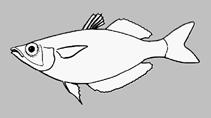
Espinhos dorsais (total) : 4 - 6; Raios dorsais moles (total) : 9 - 12; Espinhos anais: 1; Raios anais moles: 17 - 21. Melanotaenia rubrivittata is distinguished by the following combination of characters: IV-VI-I,9-12 (usually V-I,10-11) dorsal-fin rays; I,17-21 (usually I,18-20) anal-fin rays; 10-13 (usually 11-12) pectoral-fin rays; 32-33 scales on lateral line, 13-16 (usually 14-15) predorsal scales; 12 scales around caudal peduncle; 12-14 gill rakers on first arch; 11-16 (average 8.9) scales covering cheek (preopercle); snout length 3.2 (3.0-4.3) in HL; average body depth of adult males 37.7 % SL; color in life brilliant neon blue on upper two-thirds of body with five red stripes (one between each scale row); ventral portion of head and body silvery white to blue with slight pinkish hue; first dorsal fin blue; second dorsal fin blue with red basal stripe and broad red zone encompassing outer margin and posterior portion of fin; anal fin bluish with red basal stripe and red outer margin; caudal fin red, grading to bluish or translucent along posterior margin (Ref. 111039).
Body shape (shape guide): fusiform / normal.
The type specimen was collected from a small, fully shaded pond formed from previous flooding of the nearby Tirawiwa River (sometimes spelt Tiawiwa). The pond was about 12 m in diameter with an average depth of only 30 cm and substratum comprising of soft mud covered with a layer of organic debris, mainly dead leaves. Other specimens were found in a small (2-5 m width), closed-canopy rainforest stream 1.3 km northwest from the type locality. Only Melanotaenia rubrivittata and Mogurnda wapoga were collected at both sites, although a few juvenile Glossolepis leggetti were obtained from the pond habitat. Also found in a small (about 1.5-2 m wide) rainforest stream that was also inhabited by Melanotaenia rubripinnis and Chilatherina alleni (Ref. 111039).
Ciclo de vida e comportamento de acasalamento
Maturidade | Reprodução | Desova | Ovos | Fecundidade | Larvas
Allen, G.R., P.J. Unmack and R.K Hadiaty, 2015. Melanotaenia rubrivittata, a new species of rainbowfish (Melanotaeniidae) from northwestern Papua Province, Indonesia. Fishes of Sahul, Journal of the Australia New Guinea Fishes Association 29 (1):846-859. (Ref. 111039)
Categoria na Lista Vermelha da IUCN (Ref. 130435: Version 2025-2 (Global))
Ameaça para o homem
Harmless
Utilização humana
Pescarias: de interesse potencial; Aquário: Potencial
Ferramentas
Relatórios especiais
Descarregue XML
Fontes da internet
Estimativas baseadas em modelos
Índice de diversidade filogenética (Ref.
82804): PD
50 = 0.5000 [Uniqueness, from 0.5 = low to 2.0 = high].
Bayesian length-weight: a=0.01122 (0.00514 - 0.02450), b=3.04 (2.87 - 3.21), in cm total length, based on all LWR estimates for this body shape (Ref.
93245).
Nível Trófico (Ref.
69278): 2.9 ±0.4 se; based on size and trophs of closest relatives
Resiliência (Ref.
120179): Elevada, tempo mínimo de duplicação da população menor que 15 meses (Preliminary K or Fecundity.).
Vulnerabilidade da pesca (Ref.
59153): Low vulnerability (10 of 100).
🛈