Classification / Noms
Noms communs | Synonymes | Catalog of Fishes(Genre, Espèce) | ITIS | CoL | WoRMS | Cloffa
>
Atheriniformes (Silversides) >
Melanotaeniidae (Rainbowfishes, blue eyes)
Etymology: Melanotaenia: Greek, melan, -anos = black + latin, taenia = stripe (Ref. 45335); picta: From the Latin 'picta', meaning painted, in reference to its beautiful color pattern.
Environnement : milieu / zone climatique / profondeur / gamme de distribution
Écologie
; eau douce benthopélagique. Tropical
Asia: Mareremar River system in Kobroor Island, Aru Islands, Indonesia.
Taille / Poids / Âge
Maturité: Lm ? range ? - ? cm
Max length : 9.3 cm SL mâle / non sexé; (Ref. 110723); 7.9 cm SL (female)
Description synthétique
Clés d'identification | Morphologie | Morphométrie
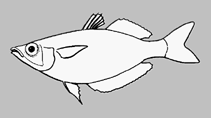
Épines dorsales (Total) : 5 - 6; Rayons mous dorsaux (Total) : 11 - 14; Épines anales: 1; Rayons mous anaux: 19 - 23. This species can be diagnosed by the following combination of characters: V-VI-I,11-14 dorsal-fin rays; I,19-23 anal-fin rays; 13-16 (usually 14) pectoral-fin rays; 35-36 scales on lateral line, 16-19 predorsal scales; 16-22 (usually > 20) cheek scales; 15-19 total gill rakers on first arch; greatest body depth of adult male 33.9 % SL; color in life generally shades of blue green to blue with metallic reflections and indication of darker blue mid-lateral stripe, most prominent on caudal peduncle where edged below with relatively broad white stripe; in situ color pattern composed of brilliant golden reflections especially conspicuous on each side of midlateral region on side of body and caudal peduncle; and reddish to yellow highlights on dorsal, anal, and caudal fins (Ref. 110723).
Body shape (shape guide): fusiform / normal.
Occupies habitat considered among the most scenic freshwater environments found at the Aru Islands, consisting of small, rainforest brooks with quiet pools interspersed with cascades to 3-4 m high. The habitat has excellent water clarity and stream channels composed of relatively smooth limestone with minimal aquatic vegetation, but abundant shelter for fishes in the form of log snags (Ref. 110723).
Cycle de vie et comportement reproducteur
Maturité | Reproduction | Frai | Œufs | Fécondité | Larves
Allen, G.R., R.K. Hadiaty, P.J. Unmack and M.V. Erdmann, 2015. Rainbowfishes (Melanotaenia: Melanotaeniidae) of the Aru Islands, Indonesia with descriptions of five new species and redescription of M. patoti Weber and M. senckenbergianus Weber. aqua, Int. J. Ichthyol. 21(2):66-108. (Ref. 110723)
Statut dans la liste rouge de l'IUCN (Ref. 130435: Version 2025-2 (Global))
Menace pour l'homme
Harmless
Utilisations par l'homme
Pêcheries: d'intérêt potentiel; Aquarium: potentiel
Outils
Articles particuliers
Télécharger en XML
Sources Internet
Estimations basées sur des modèles
Indice de diversité phylogénétique (Réf.
82804): PD
50 = 0.5000 [Uniqueness, from 0.5 = low to 2.0 = high].
Bayesian length-weight: a=0.01122 (0.00514 - 0.02450), b=3.04 (2.87 - 3.21), in cm total length, based on all LWR estimates for this body shape (Ref.
93245).
Niveau trophique (Réf.
69278): 2.9 ±0.4 se; based on size and trophs of closest relatives
Résilience (Réf.
120179): Milieu, temps minimum de doublement de population : 1,4 à 4,4 années (Preliminary K or Fecundity.).
Vulnérabilité de la pêche (Ref.
59153): Low vulnerability (10 of 100).
🛈