>
Atheriniformes (Silversides) >
Melanotaeniidae (Rainbowfishes, blue eyes)
Etymology: Melanotaenia: Greek, melan, -anos = black + latin, taenia = stripe (Ref. 45335); kolaensis: Named for its type locaity, theKola Island.
Ambiente: milieu / zona climática / intervalo de profundidade / gama de distribuição
Ecologia
; Água doce; estuarina bentopelágico. Tropical
Asia: Kola Island in Aru Islands, Indonesia.
Tamanho / Peso / Idade
Maturidade: Lm ? range ? - ? cm
Max length : 7.9 cm SL macho/indeterminado; (Ref. 110723); 6.5 cm SL (female)
Descrição breve
Chaves de identificação | Morfologia | Morfometria
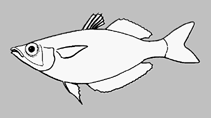
Espinhos dorsais (total) : 4 - 6; Raios dorsais moles (total) : 12 - 13; Espinhos anais: 1; Raios anais moles: 18 - 21. Melanotaenia kolaensis is distinguished by the following combination of characters: IV-VI-I,12-13 dorsal-fin rays; I,18-21 anal-fin rays; 13-14 (most frequently13) pectoral-fin rays; 33-34 (rarely 34) scales on lateral line, 14-16 predorsal scales; 17-23 cheek scales; 16-18 total gill rakers on first arch; greatest body depth of adult male 36.2 % SL; colour in life generally light blue to blue-green on back; dark blue midlateral stripe (1-2 scales wide), especially conspicuous on posterior third of body, edged below with prominent white to pale blue stripe that occupies lowermost part of caudal peduncle, extending forward to middle of sides; ventral portion of body greyish-white to pale blue except pair of dark blue, irregular stripes often present above anal fin and large, bright blue patch just behind and below pectoral-fin base; second dorsal, anal and caudal fins with reddish suffusion (Ref. 110723).
Body shape (shape guide): fusiform / normal.
The type locality is located about 11 km upstream from the sea with the main river making a gradual transition from a broad, mangrove-lined tidal stream with brackish conditions to an exceptionally narrow and steep-walled, limestone channel in woodland habitat with pure fresh water. This species was found nearly 100 m beyond the navigable (via small outboard boat) limit of the stream (Ref. 110723).
Ciclo de vida e comportamento de acasalamento
Maturidade | Reprodução | Desova | Ovos | Fecundidade | Larvas
Allen, G.R., R.K. Hadiaty, P.J. Unmack and M.V. Erdmann, 2015. Rainbowfishes (Melanotaenia: Melanotaeniidae) of the Aru Islands, Indonesia with descriptions of five new species and redescription of M. patoti Weber and M. senckenbergianus Weber. aqua, Int. J. Ichthyol. 21(2):66-108. (Ref. 110723)
Categoria na Lista Vermelha da IUCN (Ref. 130435: Version 2025-2 (Global))
Ameaça para o homem
Harmless
Utilização humana
Pescarias: de interesse potencial; Aquário: Potencial
Ferramentas
Relatórios especiais
Descarregue XML
Fontes da internet
Estimativas baseadas em modelos
Índice de diversidade filogenética (Ref.
82804): PD
50 = 0.5000 [Uniqueness, from 0.5 = low to 2.0 = high].
Bayesian length-weight: a=0.01122 (0.00514 - 0.02450), b=3.04 (2.87 - 3.21), in cm total length, based on all LWR estimates for this body shape (Ref.
93245).
Nível Trófico (Ref.
69278): 2.9 ±0.4 se; based on size and trophs of closest relatives
Resiliência (Ref.
120179): Médio, tempo mínimo de duplicação da população 1,4 - 4,4 anos (Preliminary K or Fecundity.).
Vulnerabilidade da pesca (Ref.
59153): Low vulnerability (10 of 100).
🛈