>
Beloniformes (Needle fishes) >
Exocoetidae (Flyingfishes)
Etymology: Hirundichthys: latin, hirundo = swift; 1300 + Greek, ichthys = fish (Ref. 45335).
Περιβάλλον: περιβάλλον / κλιματική ζώνη / εύρος βάθους / εύρος διανομής
Οικολογία
Θαλασσινό(ά) pelagic-oceanic; εύρος βάθους 0 - ? m. Subtropical
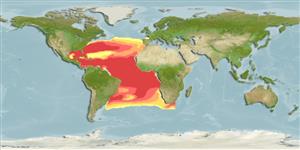
Atlantic Ocean. NW Atlantic (Massachussetts south along the US) Bermuda, the Bahamas ad throughout the Gulf of Mexico and the Caribbean Sea. East of 30° W are extremely rare and could possibly represent strays of H. rondeletti. Confirmed to occur in Portugal, the Azores and Canary Islands.
Μέγεθος / Βάρος / Ηλικία
Γεννητική Ωρίμανση: Lm ? range ? - ? cm
Max length : 24.0 cm SL αρσενικό/απροσδιόριστο; (Ref. 109257)
Σύντομη περιγραφή
Κλείδες προσδιορισμού | Μορφολογία | Μορφομετρία
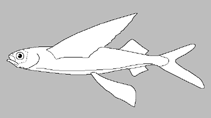
Μαλακές ραχιαίες ακτίνες (συνολικά) : 10 - 13; Μαλακές εδρικές ακτίνες: 10 - 13; Σπόνδυλοι: 44 - 47. This species is distinguished by the following characters: elongated body nearly rectangular in cross-section, almost flat ventrally; its depth 5.2-6.4 times in standard length (SL): vertebrae 44-47; predorsal scales 25-31; scales in transverse row 6.5 to 8.5, usually 7.5; head 4.2-5.2 times in SL;
eye 3.1-3.3 times in head; jaws subequal, the teeth conspicuous, conical; no palatine teeth; gill rakers on first arch 24-29; low dorsal fin with 10-13 rays; anal fin with 10-13 rays, originating
slightly before, or 1 to 2 rays behind dorsal-fin origin; pectoral fins 1.2-1.4 times in SL, with 16-19 rays and the first two rays unbranched; pelvic fins 2.5-3.4 times in SL, inserted slightly nearer to posterior margin of opercle than origin of caudal-fin base; juveniles are not barbelled; colour of body dark above, pale below, the dorsal and caudal fins greyish and anal fin transparent; pectoral fins black without unpigmented cross-band and with a narrow light outer margin; pelvic fins usually with black spot. Juveniles less than 5,0 cm SL have a few dark transverse vertical bands on body; dorsal, pectoral and pelvic fins mottled with dark spots and bands (Ref. 109257)..
Body shape (shape guide): elongated; Cross section: angular.
Feeds on zooplankton. Eggs demersal. No importance to fisheries (Ref. 109257)..
Κύκλος ζωής και συμπεριφορά ζευγαρώματος
Γεννητική Ωρίμανση | Αναπαραγωγή | Γεννοβολία | Αβγά | Γονιμότητα | Προνύμφες
Carpenter, K.E. and N. De Angelis (eds.), 2016. The living marine resources of the Eastern Central Atlantic. Vol. 3: Bony fishes part 1 (Elopiformes to Scorpaeniformes). FAO Species Identification Guide for Fishery Purposes, Rome, FAO. pp. 1511-2350. (Ref. 109257)
Κατάσταση Κόκκινου Καταλόγου IUCN (Ref. 130435: Version 2025-2 (Global))
Απειλή για τον άνθρωπο
Harmless
Ανθρώπινες χρήσεις
αλιεία: χωρίς ενδιαφέρον
Εργαλεία
Ειδικές εκθέσεις
Λήψη XML
Διαδικτυακές πηγές
Εκτιμήσεις βάσει μοντέλων
Δείκτης φυλογενετικής ποικιλότητας (Αναφ.
82804): PD
50 = 0.5002 [Uniqueness, from 0.5 = low to 2.0 = high].
Bayesian length-weight: a=0.00646 (0.00293 - 0.01422), b=3.04 (2.85 - 3.23), in cm total length, based on LWR estimates for this (Sub)family-body shape (Ref.
93245).
Τροφικό Επίπεδο (Αναφ.
69278): 3.0 ±0.1 se; based on size and trophs of closest relatives
Ελαστικότητα (Αναφ.
120179): Υψηλό, ελάχιστος χρόνος για διπλασιασμό πληθυσμού < 15 μήνες (Preliminary K or Fecundity.).
Ευπάθεια στην αλιεία (Ref.
59153): Low vulnerability (19 of 100).
🛈