Classification / Noms
Noms communs | Synonymes | Catalog of Fishes(Genre, Espèce) | ITIS | CoL | WoRMS | Cloffa
>
Cypriniformes (Carps) >
Nemacheilidae (Brook loaches)
Etymology: Paracobitis: Greek, para = the side of + Greek, kobitis, -idos = a kind of sardine; also related with the voice Greek, kobios, Latin gobius = gudgeon (Ref. 45335); hircanica: Named from the Greek name for the southern Caspian Sea region where the species occurs, Hyrcania.
Environnement : milieu / zone climatique / profondeur / gamme de distribution
Écologie
; eau douce benthopélagique. Subtropical
Asia: Iran (tributaries of the Gorgan River).
Taille / Poids / Âge
Maturité: Lm ? range ? - ? cm
Max length : 10.5 cm TL mâle / non sexé; (Ref. 116944)
Description synthétique
Clés d'identification | Morphologie | Morphométrie
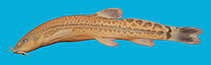
This species is distinguished from its congeners in the Middle East by the following characters, of which none are unique: this species is similar to P. atrakensis, P. smithi and P. vignai by lacking scales (vs. body fully covered in scales P. longicauda, P. rhadinaea and posterior flank behind dorsal-fin origin is covered by scales in P. malapterura, P. basharensis, P. molavii, P. persa, P. zabgawraensis); it differs from P. atrakensis (which occurs in the adjacent Atrak drainage) by the colour pattern of the caudal fin, rays are dark-brown or black, and have a hyaline base and a hyaline posterior margin (vs. rays hyaline with an irregular pattern of dark brown or black spots and elongated blotches often organized in 1-3 wide, irregularly shaped bars); it differs further from P. atrakensis in having a clearly emarginate caudal fin (vs. truncate
or slightly emarginated), a well developed axillary pelvic lobe (vs. absent) and a fine marbled or vermiculate brown colour pattern on the flank (vs. coarse marbled); it differs from the hypogean P. smithi by having normally developed eyes (vs. no eyes), an emarginate caudal fin (vs. forked) and a dark brown colour pattern (vs. no colour pattern); differs from P. vignai by having an emarginate caudal fin (vs. forked) and a roundish posterior nare opening (vs. slit-like) (Ref. 103421).
Body shape (shape guide): elongated; Cross section: oval.
The type locality of this species, Zarrin-Gol stream, is about 2 m wide, with substrate consisting of coarse gravel and boulders, fast-flowing and semi-transparent waters without submerged vegetations (Ref. 103421).
Cycle de vie et comportement reproducteur
Maturité | Reproduction | Frai | Œufs | Fécondité | Larves
Mousavi-Sabet, H., G. Sayyadzadeh, H.R. Esmaeili, S. Eaderi, R. Patimar and J. Freyhof, 2015. Paracobitis hircanica, a new crested loach from the southern Caspian Sea basin (Teleostei: Nemacheilidae). Ichthyol. Explor. Freshwat. 25(4):339-346. (Ref. 103421)
Statut dans la liste rouge de l'IUCN (Ref. 130435: Version 2025-2 (Global))
Menace pour l'homme
Harmless
Utilisations par l'homme
Pêcheries: sans intérêt
Outils
Articles particuliers
Télécharger en XML
Sources Internet
Estimations basées sur des modèles
Indice de diversité phylogénétique (Réf.
82804): PD
50 = 0.5000 [Uniqueness, from 0.5 = low to 2.0 = high].
Bayesian length-weight: a=0.00955 (0.00515 - 0.01772), b=2.98 (2.83 - 3.13), in cm total length, based on LWR estimates for this species & Genus-body shape (Ref.
93245).
Niveau trophique (Réf.
69278): 2.7 ±0.3 se; based on size and trophs of closest relatives
Résilience (Réf.
120179): Milieu, temps minimum de doublement de population : 1,4 à 4,4 années (Preliminary K or Fecundity.).
Vulnérabilité de la pêche (Ref.
59153): Low vulnerability (10 of 100).
🛈