Classificazione / Nomi
Nomi Comuni | Sinonimi | Catalog of Fishes(Genere, Specie) | ITIS | CoL | WoRMS | Cloffa
>
Siluriformes (Catfishes) >
Sisoridae (Sisorid catfishes) > Glyptosterninae
Etymology: Parachiloglanis: Greek, para = the side of + Greek, cheilos = lip + Greek, glanis = a fish that can eat the bait without touching the hook; a cat fish (Ref. 45335); bhutanensis: Named in honor of being the first fish species scientifically described from within Bhutan. The common name, Khaling Torrent Catfish, is in reference to the village of Khaling, through which flows the stream where it was discovered.
Ambiente: milieu / zona climatica / distribuzione batimetrica / gamma di distribuzione
Ecologia
; acqua dolce demersale. Temperate
Asia: Khalingchhu stream and an adjacent, unnamed stream in the headwaters of the Dangmechhu River, in the Brahmaputra drainage, Bhutan.
Dimensione / Peso / Età
Maturità: Lm ? range ? - ? cm
Max length : 10.2 cm SL maschio/sesso non determinato; (Ref. 97387)
Breve descrizione
Chiavi di identificazione | Morfologia | Morfometria
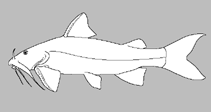
Raggi dorsali molli (totale) : 7; Raggi anali molli: 7. Parachiloglanis bhutanensis is distinguished from its only congener P. hodgarti in having 35-40 large lateral-line pores running the length of the body from the posterior edge of the head to the caudal base (vs. lateral-line pores greatly reduced or absent), large fleshy adipose fin 4.2-4.6% SL in height (vs. 2.2-4.3% SL), a deep head 47-59% HL (vs. 36-45% HL), longer inner- and outer-mandibular barbels (11.0-16.5% HL vs. 5.2-11.0% HL, and 23.9-31.8% HL vs. 14.2-23.6% HL, respectively), truncate caudal fin (vs. indented to lunate), and absence of black and white markings on caudal fin (vs. presence). It can be diagnosed from all other genera in Glyptosterninae by the lack of a post-labial grove on the lower lip (vs. presence (Ref. 97387).
Body shape (shape guide): elongated.
Occurs in streams with clear, cold-water environments, sourced from mountain springs, precipitation runoff, and snowmelt and which have little algal growth and frequent high-flow events. Observed to adhere to the bottom side of boulders, favoring areas of cascades and white water rather than pools. Found associated with large rocks with deep undercut areas versus rocks with only small refuge from the current. Adapted to a high-velocity environment with its adhesive striations on the leading rays of the paired fins for clinging to rocks and inferior mouth adapted for scraping algae and invertebrates from the substrate (Ref. 97387).
Ciclo vitale e comportamento di accoppiamento
Maturità | Riproduzione | Deposizione | Uova | Fecondità | Larve
Thoni, R.J. and D.B. Gurung, 2014. Parachiloglanis bhutanensis, a new species of torrent catfish (Siluriformes: Sisoridae) from Bhutan. Zootaxa 3869(3):306-312. (Ref. 97387)
Stato della Lista Rossa IUCN (Ref. 130435: Version 2025-2 (Global))
Minaccia per l'uomo
Harmless
Usi umani
Strumenti
Rapporti speciali
Scarica XML
Fonti Internet
Stime basate su modelli
Indice di diversità filogenetica (Fonte Biblio.
82804): PD
50 = 0.7500 [Uniqueness, from 0.5 = low to 2.0 = high].
Bayesian length-weight: a=0.00603 (0.00269 - 0.01352), b=3.08 (2.88 - 3.28), in cm total length, based on LWR estimates for this (Sub)family-body shape (Ref.
93245).
Livello trofico (Fonte Biblio.
69278): 3.2 ±0.4 se; based on size and trophs of closest relatives
Resilienza (Fonte Biblio.
120179): Medio, tempo minimo di raddoppiamento della popolazione 1.4 - 4.4 anni (Preliminary K or Fecundity.).
Vulnerabilità della pesca (Ref.
59153): Low vulnerability (10 of 100).
🛈