Ταξινόμηση / Ονόματα
Κοινά ονόματα | Συνώνυμα | Catalog of Fishes(Γένος, Είδη) | ITIS | CoL | WoRMS | Cloffa
>
Cypriniformes (Carps) >
Cyprinidae (Minnows or carps) > Barbinae
Etymology: Barbus: Latin, barbus = barbel (Ref. 45335); biharicus: Named for the Bihar Counties (there are counties with this name in both Romania and Hungary), where the species is almost exclusively distributed.
Eponymy: Sir Charles Alfred Payton (1843–1926) was a British adventurer, writer, fisherman and diplomat who was British Consul to Morocco, where this barb is found. [...] (Ref. 128868), visit book page.
Περιβάλλον: περιβάλλον / κλιματική ζώνη / εύρος βάθους / εύρος διανομής
Οικολογία
; Γλυκού νερού βενθοπελαγικό. Temperate
Europe: Sebes-Körös River, Danube River basin in Hungary and Romania; presumably in Fekete-Körös River (Crişul Negru) and Fehér-Körös River (Crişul Alb).
Μέγεθος / Βάρος / Ηλικία
Γεννητική Ωρίμανση: Lm ? range ? - ? cm
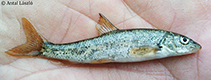
Max length : 11.5 cm SL αρσενικό/απροσδιόριστο; (Ref. 106510)
Σύντομη περιγραφή
Κλείδες προσδιορισμού | Μορφολογία | Μορφομετρία
Barbus biharicus can be distinguished by having significantly larger interorbital and preanal distance than B. balcanicus, B. carpathicus and B. petenyi, and significantly deeper head than B. carpathicus and B. petenyi. Compared to these 3 species, it has a tendency to have shorter, rounded snout, slightly longer pectoral fins, but slightly shorter anal fin. It can be further identified by having small dark spots on dorsal region of body and flanks and, to a lesser extent, head, and dark pigments on the fins occasionally form dark spots (the other species have heavy dark spots, which typically are arranged into rows on dorsal and caudal fins) (Ref. 106510).
Body shape (shape guide): elongated.
Κύκλος ζωής και συμπεριφορά ζευγαρώματος
Γεννητική Ωρίμανση | Αναπαραγωγή | Γεννοβολία | Αβγά | Γονιμότητα | Προνύμφες
Antal, L., B. László, P. Kotlík, A. Mozsár, I. Czeglédi, M. Oldal, G. Kemenesi, F. Jakab and S.A. Nagy, 2016. Phylogenetic evidence for a new species of Barbus in the Danube River basin. Mol. Phylogenet. Evol. 96:187-194. (Ref. 106510)
Κατάσταση Κόκκινου Καταλόγου IUCN (Ref. 130435: Version 2025-2 (Global))
Απειλή για τον άνθρωπο
Harmless
Ανθρώπινες χρήσεις
Εργαλεία
Ειδικές εκθέσεις
Λήψη XML
Διαδικτυακές πηγές
Εκτιμήσεις βάσει μοντέλων
Δείκτης φυλογενετικής ποικιλότητας (Αναφ.
82804): PD
50 = 0.5000 [Uniqueness, from 0.5 = low to 2.0 = high].
Bayesian length-weight: a=0.00794 (0.00367 - 0.01719), b=3.05 (2.88 - 3.22), in cm total length, based on LWR estimates for this Genus-body shape (Ref.
93245).
Τροφικό Επίπεδο (Αναφ.
69278): 3.1 ±0.4 se; based on size and trophs of closest relatives
Ελαστικότητα (Αναφ.
120179): Υψηλό, ελάχιστος χρόνος για διπλασιασμό πληθυσμού < 15 μήνες (Preliminary K or Fecundity.).
Ευπάθεια στην αλιεία (Ref.
59153): Low vulnerability (10 of 100).
🛈