分類 / 名前
共通名の | 類義語 | Catalog of Fishes(部類, 種) | ITIS | CoL | WoRMS | Cloffa
>
Cichliformes (Cichlids, convict blennies) >
Cichlidae (Cichlids) > Pseudocrenilabrinae
Etymology: Haplochromis: Greek, Haploos = single + Greek, chromis = a fish, perhaps a perch (Ref. 45335); mentatus: Specific name probably derived from the Latin 'mentum' for 'chin'; probably referring to the protruding lower jaw (Ref. 126312).
More on author: Regan.
環境:環境 / 気候帯 / 深さの範囲 / 分布範囲
生態学
; 新鮮な水 底生の漂泳性.
Deprecated: strtoupper(): Passing null to parameter #1 ($string) of type string is deprecated in /var/www/html/includes/speciessummary.lib.php on line 1589
Tropical; 0° - 1°S
Africa: endemic to Lake Edward system (Ref. 126312).
サイズ / 重さ / 年齢
成熟: Lm ? range ? - ? cm
Max length : 11.5 cm TL オス/雌雄の選別がない; (Ref. 4983)
簡単な記述
検索表 | 形態学 | 形態計測学
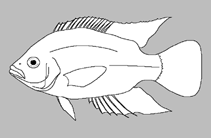
背面の脊椎 (合計) : 15 - 16; 背鰭 (合計) : 9 - 10; 肛門の骨: 3; 臀鰭: 8 - 9; 脊つい: 30 - 32. Diagnosis: Species with a piscivorous morphology; body shallow, body depth 29.0-32.3% of standard length; snout very acute in dorsal and lateral views; outer oral teeth few and large, number of upper outer teeth 28-46; vertebrae many, 30-32; dominant males yellow-green with a red anterior part of flank (Ref. 126312). Amongst piscivorous species from the Lake Edward system, Haplochromis mentatus differs from H. latifrons by the combination of a longer dorsal fin base, dorsal-fin base 50.3-54.2% of standard length vs. 47.2-50.1%; a weakly vs. strongly prominent premaxillary pedicel; a steeper sloping lower jaw side, 30-45° vs. 25-30°; and absence vs. presence of a well-defined mid-lateral band (Ref. 126312). It differs from H. rex and H. aquila by the combination of a longer caudal peduncle, caudal peduncle length 15.7-17.5% of standard length vs. 13.5-16.2%; a gentler sloping snout, 30-35° vs. 35-50°; and dominant males yellow-green with a red anterior part of flank vs. cream-coloured with an orange operculum, or light grey with a black head, respectively; further from H. rex by a lower number of infraorbital cheek scales, 3-4 vs. 5-6, rarely 4 or 7; further from H. aquila by smaller eyes, eye diameter 25.4-29.9% of head length vs. 30.0-31.5% (Ref. 126312). It differs from H. simba by the combination of a broader interorbital area, interorbital width 51.3-61.0% of head width vs. 45.5-50.4%; a larger number of outer upper jaw teeth, 28-46 vs. 22-31; absent to weakly prominent vs. strongly prominent premaxillary pedicel and mentum; and dominant males yellow-green with a red anterior part of flank vs. yellow with an orange anterior part of flank (Ref. 126312). It differs from H. glaucus by the combination of a longer caudal peduncle, caudal peduncle length 15.7-17.5% of standard length vs. 13.4-16.1%; a narrower lower pharyngeal bone, lower pharyngeal width 83.6-85.7% of lower pharyngeal length vs. 93.3-95.1%; a slightly shorter pre-pectoral distance, 33.1-38.2% of standard length vs. 36.4-39.4%; and dominant males yellow-green with a red anterior part of flank vs. uniformly blue (Ref. 126312). It differs from H. kimondo and H. quasimodo by the combination of a narrower head, head width 39.4-42.3% of head length vs. 42.0-48.1%; and dominant males yellow-green with a red anterior part of flank vs. grey dorsally and yellow or blue-black ventrally; further from H. kimondo by a very acute vs. blunt snout, and a gentler sloping snout, 30-35° vs. 40-50°; further from H. quasimodo by a shallower body, body depth 27.2-30.1% of standard length vs. 33.5-41.7% (Ref. 126312). It differs from H. falcatus by the combination of a shorter predorsal distance, 33.3-36.4% of standard length vs. 36.9-41.1%; a shorter head, head length 33.4-37.0% of standard length vs. 36.6-39.6%; straight to weakly recurved vs. strongly recurved outer oral teeth, a steeper lower jaw side, 30-45° vs. 15-25°; absence vs. presence of well-defined mid-lateral and dorsal-lateral bands (Ref. 126312). It differs from H. curvidens and H. pardus by the combination of a deeper lacrimal, 18.1-20.9% of head length vs. 16.0-18.3%; and smaller eyes, eye diameter 25.4-29.9% of headclength vs. 29.4-34.1%; further from H. pardus by dominant males yellow-green with a red anterior part of flank vs. speckled to uniformly black (Ref. 126312). It differs from H. squamipinnis by the combination of large vs. small outer oral teeth and a smaller number of outer upper jaw teeth, 28-46 vs. 46-71; a shallower body, body depth 29.0-32.3% of standard length vs. 32.4-39.3%; absence vs. presence of minute scales on proximal part of dorsal fin; and dominant males yellow-green with a red anterior part of flank vs. uniformly slate blue (Ref. 126312).
Found in offshore areas, mostly in shallow waters (Ref. 126312). Based on its morphology, most probably a piscivorous species (Ref. 126312).
ライフサイクルと交尾行動
成熟 | 繁殖 | 放精 | 卵 | 生産力 | 幼生
Mouthbrooding by females.
Vranken, N., M. Van Steenberge, A. Heylen, E. Decru and J. Snoeks, 2022. From a pair to a dozen: the piscivorous species of Haplochromis (Cichlidae) from the Lake Edward system. Eur. J. Taxon. 815:1-94. (Ref. 126312)
IUCNのレッドリストの状況は (Ref. 130435: Version 2025-2 (Global))
人間の用途
用具
特記事項
XMLをダウンロードして下さい
インターネットの情報源
モデルに基づく推定値
系統多様性指数 (参照
82804): PD
50 = 0.5000 [Uniqueness, from 0.5 = low to 2.0 = high].
Bayesian length-weight: a=0.00389 (0.00180 - 0.00842), b=3.12 (2.94 - 3.30), in cm total length, based on all LWR estimates for this body shape (Ref.
93245).
栄養段階 (参照
69278): 3.3 ±0.4 se; based on size and trophs of closest relatives
回復力 (参照
120179): 高い, 15か月以下の倍増期間の最小個体群 (Preliminary K or Fecundity.).
漁業の脆弱性 (Ref.
59153): Low vulnerability (10 of 100).
🛈