Clasificación / Nombres
Nombres comunes | Sinónimos | Catalog of Fishes(Género, Especie) | ITIS | CoL | WoRMS | Cloffa
>
Cyprinodontiformes (Rivulines, killifishes and live bearers) >
Rivulidae (Rivulines) > Cynolebiinae
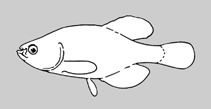
Etymology: Cynolebias: Greek, kyon = dog + Greek, odous = teeth + Greek, lebias = a kind of small fish (Ref. 45335); rectiventer: Dervied from the Latin rectus, meaning straight, and venter, meaning belly. This is in reference to the straight ventral profile of the body in males, a condition unique in Cynolebias.
Entorno: milieu / zona climática / rango de profundidad / gama de distribución
Ecología
; agua dulce demersal; rango de profundidad 1 - ? m (Ref. 97357). Tropical
South America: Verde River floodplain, São Francisco River Basin in Brazil.
Tamaño / Peso / Edad
Madurez: Lm ? range ? - ? cm
Max length : 10.2 cm SL macho / no sexado; (Ref. 97357); 8.1 cm SL (female)
Descripción breve
Claves de identificación | Morfología | Morfometría
Radios blandos dorsales (total) : 15 - 20; Radios blandos anales: 18 - 21; Vértebra: 35 - 37. Cynolebias rectiventer can be diagnosed from all species of C. perforatus group by the following characters: contact organs restricted to the seven uppermost rays of the pectoral fin in males (vs. contact organs on all rays); ventral process on the autopalatine present (vs. absent); scales absent on the base of the dorsal fin (vs. present); gill rakers slightly curved (vs. bowed); denticles situated on the gill-raker margin (vs. on the entire region); less than one third of caudal fin anteriorly covered by scales (vs. more than one third). It also differs from all congeners by having approximately straight lateral profile of the abdominal region in males (vs. convex) (Ref. 97357).
Body shape (shape guide): elongated.
Found in two adjacent and shallow temporary lagoons of about 1.0 m deep with an area of about 5 km2, within a small farm for cattle breeding, and with sparse aquatic vegetation. Collected close to the lagoon bottom (Ref. 97357).
Ciclo vital y comportamiento de apareamiento
Madurez | Reproducción | Puesta | Huevos | Fecundidad | Larva
Costa, W.J.E.M., 2014. Six new species of seasonal killifishes of the genus Cynolebias from the São Francisco river basin, Brazilian Caatinga, with notes on C. porosus (Cyprinodontiformes: Rivulidae). Ichthyol. Explor. Freshwat. 25(1):79-96. (Ref. 97357)
Situación en la Lista Roja de la UICN (Ref. 130435: Version 2025-2 (Global))
Amenaza para el ser humano
Harmless
Usos humanos
Herramientas
Informes especiales
Descargar XML
Fuentes de Internet
Estimaciones basadas en modelos
Índice de diversidad filogenética (Referencia
82804): PD
50 = 0.5000 [Uniqueness, from 0.5 = low to 2.0 = high].
Bayesian length-weight: a=0.01122 (0.00514 - 0.02450), b=3.04 (2.87 - 3.21), in cm total length, based on all LWR estimates for this body shape (Ref.
93245).
Nivel trófico (Referencia
69278): 3.3 ±0.4 se; based on size and trophs of closest relatives
Resiliencia (Referencia
120179): Alto, población duplicada en un tiempo mínimo inferior a 15 meses (Preliminary K or Fecundity.).
Vulnerabilidad pesquera (Ref.
59153): Low vulnerability (10 of 100).
🛈