Klassifizierung / Names
Namen | Synonyme | Catalog of Fishes(Gattung, Arten) | ITIS | CoL | WoRMS | Cloffa
>
Cypriniformes (Carps) >
Cyprinidae (Minnows or carps) > Smiliogastrinae
Etymology: Puntius: Lantin, punctum = point, the point of the sword (Ref. 45335); nelsoni: Named for Dr. Nelson P. Abraham, Associate Professor, St. Thomas College, Kozhencherry, Kerala.
Eponymy: Dr Nelson P Abraham is an Indian zoologist and ichthyologist who is an Associate Professor at St. [...] (Ref. 128868), visit book page.
Umwelt: Milieu / Klimazone / Tiefenbereich / Verbreitungsgebiet
Ökologie
; süßwasser benthopelagisch; tiefenbereich 1 - 10 m (Ref. 104747). Tropical
Asia: India.
Größe / Gewicht / Alter
Geschlechtsreife: Lm ? range ? - ? cm
Max length : 9.1 cm SL Männchen/unbestimmt; (Ref. 104747)
Kurzbeschreibung
Bestimmungsschlüssel | Morphologie | Morphometrie
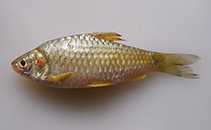
This species is distinguished from its close congeners by the following set of characters: maxillaries are feeble, short and never reach orbit, the nostrils inserted in the middle of orbit and snout tip, head deeper (89.3- 96.2 % HL), mouth gape wider (29.2- 31.0 % HL) and snout shorter (22.7- 28.8 % HL); body and fins are yellowish; a narrow light bluish green mark on summit of occiput; outer to operculum with numerous fine black dots present in the form of a thin band which of both sides join together at occiput; differs from P. dorsalis, P. sophore and P. stigma in lacking (vs. presence) any color spot on the base of dorsal fin; differs further from P. dorsalis, P. sophore, P. parrah, P. viridis and P. chola in having a wider head; differs from P. madhusoodani in having 5½ (vs. 4½) scales between lateral line and dorsal fin; differs from P. mahecola in having 25- 26 lateral line scales (vs. 22) and 3½ scales (vs. 2½) between lateral line and ventral fin (Ref. 104747).
Body shape (shape guide): fusiform / normal; Cross section: compressed.
This species occurs in Kallumkal, a site of merging of Pamba River with Manimala River. This part of the river is blanketed by mud dominant sediments, the sand occurs as discrete patches within the mud dominant deposits. The depth and width of the channel at Kallumkal ranges from 1 to 10 and 30 to 85 m, respectively; the reach has a bank height of 1 to 2 m from the general water
level. Riparian vegetation is moderate; major flora includes Bambusa bambos, B. vulgaris, Hibiscus tiliaceus and Ochreinauclea missionis; and Cynodon dactylon and
Cymbopogon flexuosus are major grass species in this area. Some fishes co-occurring with this species in the region are: Rasbora dandia, Osteobrama bakeri, Amblypharyngodon microlepis, Dawkinsia filamentosus, Haludaria fasciatus, Puntius parrah, P. viridis, Pethia ticto, Gonoproktopterus kurali, Catla catla, Labeo rohita, Labeo dussumieri, Cirrhina mrigala, Horabagrus brachysoma, and Wallago attu (Ref. 104747).
Lebenszyklus und Paarungsverhalten
Geschlechtsreife | Fortpflanzung | Ablaichen | Eier | Fruchtbarkeit | Larven
Plamoottil, M., 2014. Puntius nelsoni, Systomus chryseus and S. rufus (Cypriniformes: Cyprinidae), three new fish species from Kerala, India. Int'l J of Fauna and Biological Stud. 1(6):135-145. (Ref. 104747)
IUCN Rote Liste Status (Ref. 130435: Version 2025-2 (Global))
Bedrohung für Menschen
Harmless
Nutzung durch Menschen
Fischereien: nicht kommerziell
Tools
Zusatzinformationen
Download XML
Internet Quellen
Schätzungen auf der Grundlage von Modellen
Phylogenetischer Diversitätsindex (Ref.
82804): PD
50 = 0.5000 [Uniqueness, from 0.5 = low to 2.0 = high].
Bayesian length-weight: a=0.01259 (0.00566 - 0.02798), b=3.02 (2.85 - 3.19), in cm total length, based on LWR estimates for this Genus-body shape (Ref.
93245).
Trophische Ebene (Ref.
69278): 2.6 ±0.1 se; based on size and trophs of closest relatives
Widerstandsfähigkeit (Ref.
120179): hoch, Verdopplung der Population dauert weniger als 15 Monate. (Preliminary K or Fecundity.).
Anfälligkeit der Fischerei (Ref.
59153): Low vulnerability (10 of 100).
🛈