Classificazione / Nomi
Nomi Comuni | Sinonimi | Catalog of Fishes(Genere, Specie) | ITIS | CoL | WoRMS | Cloffa
>
Siluriformes (Catfishes) >
Doradidae (Thorny catfishes) > Doradinae
Etymology: Nemadoras: Greek, nema, -atos = filament + Greek, dora = skin (Ref. 45335); cristinae: Named for Maria Cristina Sabaj Pérez, teacher at Friends' Central School, Wynnewood, Pennsylvania, for her contributions to the collection of the type series and to the well-being of the senior co-author, videlicet course corrections over paths polished and rough.
Eponymy: Mrs Maria Cristina Sabaj Pérez, is a teacher at Friends’ Central School, Wynnewood, Pennsylvania. [...] (Ref. 128868), visit book page.
Ambiente: milieu / zona climatica / distribuzione batimetrica / gamma di distribuzione
Ecologia
; acqua dolce demersale. Tropical
South America: upper Meta (Orinoco drainage)in Colombia, upper Amazonas circa Iquitos and río Santiago (tributary of Marañon) in Peru; middle Amazonas (Solimões) from mouth of Putumayo/Iça to that of Madeira, Brazil; and Madeira basin from its mouth to rio Madre de Dios in Peru.
Dimensione / Peso / Età
Maturità: Lm ? range ? - ? cm
Max length : 12.4 cm SL maschio/sesso non determinato; (Ref. 96153)
Breve descrizione
Chiavi di identificazione | Morfologia | Morfometria
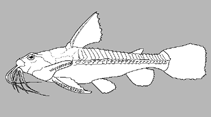
Spine dorsali (totale) : 2; Raggi dorsali molli (totale) : 6. Nemadoras cristinae differs from all congeners by the possession of the following characters: 3-9 premaxillary teeth in approximately two rows in juveniles and adults; outermost teeth weakly spatulate and innermost more acicular (vs. premaxillary edentulous in adults of all congeners and limited to 1-6 acicular teeth in juveniles of N. elongatus, N. humeralis, N. leporhinus and N. ternetzi); and mental barbels with extremely elongate (filiform) papillae, length of longest about 4-7 times its width at base (vs. papillae shorter, length of longest <3 times its width at base). It can be further differentiated from very similar species N. leporhinus, by having shaft and primary fimbriae of maxillary barbel smooth (vs. outer margin of shaft and margins of primary fimbriae with distinct secondary fimbriae) (Ref. 96153).
Body shape (shape guide): elongated.
Occurs in the main channels of whitewater (sediment rich) rivers. Collected using gill nets, bottom trawls to depths of 0.6-13.9 m, and long floating nets pulled by canoe in the main channels of large rivers. Feeds on larval insects (Ref. 96153).
Ciclo vitale e comportamento di accoppiamento
Maturità | Riproduzione | Deposizione | Uova | Fecondità | Larve
Sabaj Pérez, M.H., H. Mariangeles Arce, L.M. Sousa and J.L.O. Birindelli, 2014. Nemadoras cristinae, a new species of thorny catfish (Siluriformes: Doradidae) with redescription of its congeners. Proc. Acad. Nat. Sci. Philadelphia 163(1):133-178. (Ref. 96153)
Stato della Lista Rossa IUCN (Ref. 130435: Version 2025-2 (Global))
Minaccia per l'uomo
Harmless
Usi umani
Strumenti
Rapporti speciali
Scarica XML
Fonti Internet
Stime basate su modelli
Indice di diversità filogenetica (Fonte Biblio.
82804): PD
50 = 0.5625 [Uniqueness, from 0.5 = low to 2.0 = high].
Bayesian length-weight: a=0.01479 (0.00648 - 0.03378), b=2.99 (2.79 - 3.19), in cm total length, based on LWR estimates for this (Sub)family-body shape (Ref.
93245).
Livello trofico (Fonte Biblio.
69278): 2.8 ±0.4 se; based on size and trophs of closest relatives
Resilienza (Fonte Biblio.
120179): Alto, tempo minimo di raddoppiamento della popolazione meno di 15 mesi (Preliminary K or Fecundity.).
Vulnerabilità della pesca (Ref.
59153): Low vulnerability (10 of 100).
🛈