>
Anabantiformes (Gouramies, snakeheads) >
Badidae (Chameleonfishes)
Etymology: Badis: 'badis' is presumably a Bengali local name, possibly derived from 'bhedo' or 'bheda', but it lacks a proper reference. Probably incorrect etymology (J. Müller, pers. comm., April 2021, after information from native speakers); autumnum: From the Latin noun autumnum, meaning autumn, in allusion to numerous colors of autumn which the new species can display during various moods; combinations of brown, black, yellow and orange.
Lingkungan: lingkungan / zona iklim / kisaran kedalaman / jangkauan distribusi
Ekologi
; air tawar pelagis, permukaan. Tropical
Asia: Rathbari stream, Singimari River drainage in West Bengal, India.
Ukuran / Berat / umur
Kematangan: Lm ? range ? - ? cm
Max length : 3.6 cm SL jantan/; (Ref. 103291)
deskripsi pendek
Kunci identifiaksi (pengenalan) | Morfologi | Morfometrik
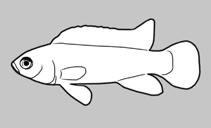
Duri punggung (Keseluruhan (total)) : 15 - 17; duri punggung lunak (Keseluruhan (total)) : 10 - 11; Duri dubur: 3; Sirip dubur lunak: 7 - 9; vertebrata, bertulang belakang: 26. Badis autumnum is distinguished from all other congeners by its color pattern consisting of two autapomorphies. It can be diagnosed from all members of the B. badis group (B. badis, B. chittagongis, B. dibruensis, B. ferrarisi, B. kanabos, B. soraya and B. tuivaiei) by the absence of a blotch on the superficial part of the cleithrum above pectoral-fin base; from all members of the B. assamensis group (B. assamensis and B. blosyrus) by the absence of a posterodorsal opercular blotch and the absence of two parallel rows of dark spots and alternating light and dark stripes along its physique; from all species of the B. ruber group (B. khwae, B. ruber and B. siamensis) by the absence of a cleithral blotch and absence of a blotch on the dorsolateral aspect of the caudal peduncle; from all members of the B. corycaeus group (B. corycaeus and B. pyema) by the absence of an ocellus on the caudal-fin base; from B. kyar by the presence of a conspicuous median black blotch on the caudal peduncle; from B. singenensis by the absence of a posterodorsal opercle blotch and absence of three dorsal-fin blotches and a single round blotch on the anal-fin base; from B. juergenschmidti by the absence of white margins on dorsal and ventral aspects of the caudal fin in males and presence of a strongly curved caudal-fin base bar; and from B. britzi by the presence of a conspicuous median black blotch on the caudal peduncle. It is very similar to B. andrewraoi and B. kyanos in color pattern, from which it can be distinguished by two unique characters that also distinguish it from all congeners: presence of a blotch above the base of the opercular spine, and of a conspicuous dark blotch on pectoral-fin base. It also differs from B. kyanos in having 16-18 scales around caudal peduncle (vs. 18-19). In addition, it can be diagnosed from all congeners by the presence of a black caudal-fin margin, outlining entire fin; and from B. andrewraoi by having 16-18 scales around caudal peduncle (vs. 18) (Ref. 103291).
Body shape (shape guide): fusiform / normal.
Found in a swamp-like area. Observed in captivity to display a cave-brooding behavior, with the males guarding and fanning the eggs and protecting a small area surrounding the cave (e.g. coconut shells, photo canisters). Parental care ceases when larvae are at the free-swimming stage (Ref. 103291).
Siklus hidup dan perilaku kawin
Kematangan | Reproduksi, perkembang biakan | Pemijahan | telur-telur | Fekunditas | Larva
Valdesalici, S. and S. Van Der Voort, 2015. Four new species of the Indo-Burmese genus Badis from West Bengal, India (Actinopterygii: Perciformes: Badidae). Zootaxa 3985(3):391-408. (Ref. 103291)
Status IUCN Red List (Ref. 130435: Version 2025-2 (Global))
ancaman kepada manusia
Harmless
penggunaan manusia
Alat, peralatan
laporan khas
muat turun XML
Sumber internet
Estimasi berdasarkan model
Indeks keanekaragaman filogenetik (Acuan
82804): PD
50 = 0.5000 [Uniqueness, from 0.5 = low to 2.0 = high].
Bayesian length-weight: a=0.01175 (0.00503 - 0.02745), b=2.93 (2.73 - 3.13), in cm total length, based on LWR estimates for this (Sub)family-body shape (Ref.
93245).
Tingkat Trofik (Acuan
69278): 3.2 ±0.4 se; based on size and trophs of closest relatives
Kerentanan Penangkapan Ikan (Ref.
59153): Low vulnerability (10 of 100).
🛈