Klassifizierung / Names
Namen | Synonyme | Catalog of Fishes(Gattung, Arten) | ITIS | CoL | WoRMS | Cloffa
>
Siluriformes (Catfishes) >
Sisoridae (Sisorid catfishes) > Sisorinae
Etymology: magna: The species epithet is a Latin adjective meaning ‘great’, in allusion to this being the largest of the 20 known species of Pseudolaguvia.. Feminine.
Umwelt: Milieu / Klimazone / Tiefenbereich / Verbreitungsgebiet
Ökologie
; süßwasser benthopelagisch. Subtropical
Asia: Jiya stream in Arunachal Pradesh, India.
Größe / Gewicht / Alter
Geschlechtsreife: Lm ? range ? - ? cm
Max length : 4.7 cm SL Männchen/unbestimmt; (Ref. 98400)
Kurzbeschreibung
Bestimmungsschlüssel | Morphologie | Morphometrie
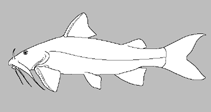
Rückenflossenstacheln (insgesamt) : 1; Rückenflossenweichstrahlen (insgesamt) : 6; Afterflossenweichstrahlen: 9 - 10; Wirbelzahl: 27 - 29. Pseudolaguvia magna is diagnosed from all species of the genus Pseudolaguvia by the possession of the following unique characters: larger body (up to 4.7 cm SL vs. a maximum of 3.56 cm SL); mid-dorsal region with two pale-brown to cream patches (one rectangular to elliptical patch on mid-interdorsal region, and another indistinct elliptical patch in between the adipose and caudal fins); broader rhomboidal thoracic adhesive apparatus; small pale-brown to cream round spot on the ventrolateral side of the head, almost perpendicular to the eye; and absence of pale-brown to cream-colored cross-bands on the body (which it shares with P. inornata, P. austrina, P. virgulata and P. assula) (Ref. 98400).
Found in stream with clear, moderately flowing water. Occurs syntopically with Pseudolaguvia jiyaensis. Both Pseudolaguvia jiyaensis and Pseudolaguvia magna were collected along with species of Psilorhynchus, Barilius, and Danio from the same collection locality in a microhabitat consisting of small to medium-sized stones, pebbles, cobbles with light green algae, and deposits of sand particles near banks (Ref. 98400).
Lebenszyklus und Paarungsverhalten
Geschlechtsreife | Fortpflanzung | Ablaichen | Eier | Fruchtbarkeit | Larven
Tamang, L., B. Sinha, 2014. Two new species of the South Asian catfish genus Pseudolaguvia from northeastern India (Teleostei: Sisoridae). Zootaxa 3887(1):37-54. (Ref. 98400)
IUCN Rote Liste Status (Ref. 130435: Version 2025-2 (Global))
Bedrohung für Menschen
Harmless
Nutzung durch Menschen
Fischereien: nicht kommerziell
Tools
Zusatzinformationen
Download XML
Internet Quellen
Schätzungen auf der Grundlage von Modellen
Phylogenetischer Diversitätsindex (Ref.
82804): PD
50 = 0.5000 [Uniqueness, from 0.5 = low to 2.0 = high].
Bayesian length-weight: a=0.00676 (0.00310 - 0.01476), b=3.03 (2.85 - 3.21), in cm total length, based on LWR estimates for this (Sub)family-body shape (Ref.
93245).
Trophische Ebene (Ref.
69278): 3.1 ±0.4 se; based on size and trophs of closest relatives
Widerstandsfähigkeit (Ref.
120179): hoch, Verdopplung der Population dauert weniger als 15 Monate. (Preliminary K or Fecundity.).
Anfälligkeit der Fischerei (Ref.
59153): Low vulnerability (10 of 100).
🛈