Classification / Noms
Noms communs | Synonymes | Catalog of Fishes(Genre, Espèce) | ITIS | CoL | WoRMS | Cloffa
>
Gadiformes (Cods) >
Macrouridae (Grenadiers or rattails)
Etymology: Hymenocephalus: Named for its transparent membrane-like head covering (‘‘hymen head’’) and fragile nature of head bones (Ref. 100825); iwamotoi: Named for Tomio Iwamoto, San Francisco, U.S.A.
Eponymy: Dr Tomio Iwamoto (d: 1939) is Curator Emeritus, Ichthyology at the Institute for Biodiversity Science and Sustainability at California Academy of Sciences. [...] (Ref. 128868), visit book page.
Environnement : milieu / zone climatique / profondeur / gamme de distribution
Écologie
marin benthopélagique; profondeur ? - 242 m (Ref. 98298). Tropical
Eastern Indian Ocean: Western Australia (Browse Island).
Taille / Poids / Âge
Maturité: Lm ? range ? - ? cm
Max length : 10.3 cm TL mâle / non sexé; (Ref. 98298)
Description synthétique
Clés d'identification | Morphologie | Morphométrie
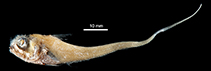
Épines dorsales (Total) : 2; Rayons mous dorsaux (Total) : 6 - 7. This small species (<10.5 cm TL) is distinguished by the following characters: pelvic fin rays 8 (7-9); pectoral 12-13; D1II,6-7; gill rakers 17-20; long barbel 40-46% HL, reaching vertical through rear end of orbit; orbit 35-38% HL; rounded snout, barely protruding, short 15-19% HL; posterior luminescent lens round, ventral striae extending to near periproct: compressed otolith, otholith length to height (OL:OH) is 0.95; colliculi separated, small; pseudocolliculum small, total colliculum length to pseudocolliculum length (TCL:PCL), 1.8-2.0 (Ref. 98298).
Cross section: angular.
Cycle de vie et comportement reproducteur
Maturité | Reproduction | Frai | Œufs | Fécondité | Larves
Schwarzhans, W., 2014. Head and otolith morphology of the genera Hymenocephalus, Hymenogadus and Spicomacrurus (Macrouridae), with the description of three new species. Zootaxa 3888(1):1-73. (Ref. 98298)
Statut dans la liste rouge de l'IUCN (Ref. 130435: Version 2025-2 (Global))
Menace pour l'homme
Harmless
Utilisations par l'homme
Outils
Articles particuliers
Télécharger en XML
Sources Internet
Estimations basées sur des modèles
Indice de diversité phylogénétique (Réf.
82804): PD
50 = 0.5000 [Uniqueness, from 0.5 = low to 2.0 = high].
Bayesian length-weight: a=0.00219 (0.00111 - 0.00432), b=3.20 (3.03 - 3.37), in cm total length, based on LWR estimates for this (Sub)family-body shape (Ref.
93245).
Niveau trophique (Réf.
69278): 3.3 ±0.4 se; based on size and trophs of closest relatives
Résilience (Réf.
120179): Haut, temps minimum de doublement de population inférieur à 15 mois (Preliminary K or Fecundity.).
Vulnérabilité de la pêche (Ref.
59153): Low vulnerability (10 of 100).
🛈