Klassifizierung / Names
Namen | Synonyme | Catalog of Fishes(Gattung, Arten) | ITIS | CoL | WoRMS | Cloffa
>
Perciformes/Uranoscopoidei (Sand dwellers) >
Ammodytidae (Sand lances)
Etymology: Bleekeria: He researched the fishes from India and Malaysia, 1862-1878 (Ref. 45335); estuaria: Named for its being collected from an estuary, an unexpected habitat for an ammodytid fish.
Eponymy: Dr Pieter Bleeker (1819–1878) was an ichthyologist and army surgeon commissioned (1841) by the Dutch East India Company. [...] (Ref. 128868), visit book page.
Umwelt: Milieu / Klimazone / Tiefenbereich / Verbreitungsgebiet
Ökologie
seewasser; brackwasser benthopelagisch; tiefenbereich 0 - 5 m (Ref. 97535). Tropical
Western Indian Ocean: Mozambique.
Größe / Gewicht / Alter
Geschlechtsreife: Lm ? range ? - ? cm
Max length : 6.3 cm SL Männchen/unbestimmt; (Ref. 97535)
Kurzbeschreibung
Bestimmungsschlüssel | Morphologie | Morphometrie
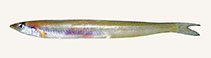
Rückenflossenweichstrahlen (insgesamt) : 42; Afterflossenweichstrahlen: 15; Wirbelzahl: 53. This species is distinguished from its congeners by the following characters: D 42; A 15; pectoral-fin rays 14, the fins 5.7 in SL (longest among species in this genus); no pelvic fins; 99 lateral-line scales; scales weakly ctenoid; a single scale dorsally on opercle; without gap in subocular sensory canal; 53 vertebrae; body depth 9.5 in SL; head short, head length 4.9 in SL; moderately large eye, 4.3 in HL; oblique mouth moderately large, the upper-jaw length 3.35 in HL; strongly projecting lower jaw, tip narrowly rounded; small slender teeth on side of upper jaw 22, 2 or 3 anteriorly on side of lower jaw; colour when fresh light olive-gray, with scale edges narrowly blackish dorsally on body, progressively less ventrally, the abdomen silvery white with a broad dorsal iridescent blue zone containing a central dusky reddish area, the operculum and isthmus are silvery and blue, a large orange-yellow area before pectoral fin, the snout dusky olive, caudal fin gray with a narrow blackish posterior margin, the rays with blackish edges and pectoral fins whitish; colour when preserved yellowish brown, scales dorsally on body to and including those of lateral-line scales very finely stippled with black, scales below lateral line with progressively less dark pigment, operculum with silvery patches, the fin rays pale yellowish, with anterior edge of dorsal rays finely dotted with black, and fin membranes are translucent. It differs from its congeners by having the shortest head, 4.9 in SL (shortest head for other species is 4.75 in SL, B. murtii<>/i); the longest pectoral fins, 5.7 in SL (longest for other species is 7.35 in SL, B. kallolepis); and by 3/17 transverse scales (others with more than 4/19 transverse scales) (Ref. 97535).
Cross section: oval.
Lebenszyklus und Paarungsverhalten
Geschlechtsreife | Fortpflanzung | Ablaichen | Eier | Fruchtbarkeit | Larven
Randall, J.E. and H. Ida, 2014. Three new species of sand lances (Perciformes: Ammodytidae) from the southwest Indian Ocean. J. Ocean Sci. Found. 12:1-11. (Ref. 97535)
IUCN Rote Liste Status (Ref. 130435: Version 2025-2 (Global))
Bedrohung für Menschen
Harmless
Nutzung durch Menschen
Tools
Zusatzinformationen
Download XML
Internet Quellen
Schätzungen auf der Grundlage von Modellen
Phylogenetischer Diversitätsindex (Ref.
82804): PD
50 = 0.5039 [Uniqueness, from 0.5 = low to 2.0 = high].
Bayesian length-weight: a=0.00324 (0.00142 - 0.00739), b=3.07 (2.88 - 3.26), in cm total length, based on LWR estimates for this (Sub)family-body shape (Ref.
93245).
Trophische Ebene (Ref.
69278): 3.1 ±0.4 se; based on size and trophs of closest relatives
Widerstandsfähigkeit (Ref.
120179): hoch, Verdopplung der Population dauert weniger als 15 Monate. (Preliminary K or Fecundity.).
Anfälligkeit der Fischerei (Ref.
59153): Low vulnerability (10 of 100).
🛈