Klassifizierung / Names
Namen | Synonyme | Catalog of Fishes(Gattung, Arten) | ITIS | CoL | WoRMS | Cloffa
>
Perciformes/Uranoscopoidei (Sand dwellers) >
Ammodytidae (Sand lances)
Etymology: Bleekeria: He researched the fishes from India and Malaysia, 1862-1878 (Ref. 45335); profunda: Name from Latin meaning deep, referring to its capture by trawl at a depth of 237-240 m, the deepest known for an ammodytid fish.
Eponymy: Dr Pieter Bleeker (1819–1878) was an ichthyologist and army surgeon commissioned (1841) by the Dutch East India Company. [...] (Ref. 128868), visit book page.
Umwelt: Milieu / Klimazone / Tiefenbereich / Verbreitungsgebiet
Ökologie
seewasser benthopelagisch; tiefenbereich 237 - 240 m (Ref. 97535). Subtropical
Western Indian Ocean: Saya de Malha Bank.
Größe / Gewicht / Alter
Geschlechtsreife: Lm ? range ? - ? cm
Max length : 12.1 cm SL Männchen/unbestimmt; (Ref. 97535)
Kurzbeschreibung
Bestimmungsschlüssel | Morphologie | Morphometrie
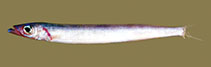
Rückenflossenweichstrahlen (insgesamt) : 49; Afterflossenweichstrahlen: 20; Wirbelzahl: 62. This species is distinguished by the following characters: D 49; A 20; pectoral-fin rays 16; pelvic fins 5; lateral-line scales 151; gill rakers 8 + 21; absence of gap in subocular sensory canal; vertebrae 62; body depth at dorsal-fin origin 8.95 in SL: head length 4.15 in SL; eye large, 4.4 in HL; mouth oblique and moderately large, the upper-jaw length 3.65 in HL; lower jaw projecting a half eye diameter anterior to opening of mouth, the tip narrowly rounded; mouth forming an angle of about 40° to axis of body; small, slender, well-spaced teeth in jaws; pelvic fins small, 4.2 in HL; color in alcohol: dorsal half of body pale yellowish brown, the scales narrowly edged in blackish, except on lateral line; ventral half of body pale yellowish white; color when fresh: grayish blue on about dorsal third of body anteriorly, progressively less posteriorly, with whitish lateral line visible within the blue, extending behind upper end of gill opening, progressively fainter posteriorly, interorbital blue, grading to gray on nape, the operculum and chest are white, snout, jaws, and ventral head are mainly dark red, the front of lower jaw blue, except for a small gray anterior nodule (the deep red coloration on the snout, ventrally on the head, and as an oblique band from the opercle to the pectoral-fin base are natural or from the trauma of the trawl) (Ref. 97535).
Cross section: oval.
Lebenszyklus und Paarungsverhalten
Geschlechtsreife | Fortpflanzung | Ablaichen | Eier | Fruchtbarkeit | Larven
Randall, J.E. and H. Ida, 2014. Three new species of sand lances (Perciformes: Ammodytidae) from the southwest Indian Ocean. J. Ocean Sci. Found. 12:1-11. (Ref. 97535)
IUCN Rote Liste Status (Ref. 130435: Version 2025-2 (Global))
Bedrohung für Menschen
Harmless
Nutzung durch Menschen
Fischereien: bycatch
Tools
Zusatzinformationen
Download XML
Internet Quellen
Schätzungen auf der Grundlage von Modellen
Phylogenetischer Diversitätsindex (Ref.
82804): PD
50 = 0.5039 [Uniqueness, from 0.5 = low to 2.0 = high].
Bayesian length-weight: a=0.00324 (0.00142 - 0.00739), b=3.07 (2.88 - 3.26), in cm total length, based on LWR estimates for this (Sub)family-body shape (Ref.
93245).
Trophische Ebene (Ref.
69278): 3.2 ±0.4 se; based on size and trophs of closest relatives
Widerstandsfähigkeit (Ref.
120179): hoch, Verdopplung der Population dauert weniger als 15 Monate. (Preliminary K or Fecundity.).
Anfälligkeit der Fischerei (Ref.
59153): Low vulnerability (10 of 100).
🛈