klasifikasi / Nama
Nama-nama umum | Sinonim (persamaan) | Catalog of Fishes(Marga, Jenis) | ITIS | CoL | WoRMS | Cloffa
>
Cichliformes (Cichlids, convict blennies) >
Cichlidae (Cichlids) > Cichlasomatinae
Etymology: Bujurquina: A name created by Kullander, taken from a native Peruvian word for these cichlids, "bujurqui" or "bufurque"; 1983-1986; pardus: From the Ancient Greek pardos, meaning leopard, in allusion to the pattern of dark blackish/brown flank spots. A noun in apposition.
Lingkungan: lingkungan / zona iklim / kisaran kedalaman / jangkauan distribusi
Ekologi
; air tawar bentopelagis; pH range: 6.4 - ?; kisaran kedalaman 1 - ? m (Ref. 96081). Tropical; 24°C - ? (Ref. 96081)
South America: Rio Danta, Rio Tigre drainage in Ecuador.
Ukuran / Berat / umur
Kematangan: Lm ? range ? - ? cm
Max length : 7.7 cm SL jantan/; (Ref. 96081)
deskripsi pendek
Kunci identifiaksi (pengenalan) | Morfologi | Morfometrik
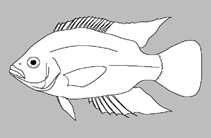
Duri punggung (Keseluruhan (total)) : 13 - 14; duri punggung lunak (Keseluruhan (total)) : 9 - 10; Duri dubur: 3; Sirip dubur lunak: 8. Bujurquina pardus is distinguished from all other congeners by having small, square or tapered black spots ('pardus type') in the region of overlap between the scale base and the anterior overlaying scale's margin. It differs from all other Bujurquina species (B. huallagae, B. moriorum, B. peregrinabunda, and B. ortegai) by the presence of white hyaline margins on the dorsal-fin lappets. It can be distinguished from all congeners except B. eurhinus, B. robusta, B. labiosa, B. huallagae, and B. oenolaemus by having a short pectoral fins (<32% of SL). It further differs from B. oenolaemus, B. cordemadi, B. tambopatae, B. eurhinus, B. labiosa, B. robusta, B. apoparuana, B. hophrys, B. megalospilus, B. ortegai, B. mariae, and B. zamorensis by the presence of light spotting on the spinous dorsal fin. It can be diagnosed from a very similar species B. huallagae, on the basis of the presence of white dorsal-fin lappet margins (rather than black), a strongly curved suborbital stripe (rather than straight or nearly straight), a complete bar 7 (rather than divided), and in having faint buccal stripes (rather than dark buccal spots) (Ref. 96081).
Found in a whitewater habitat of Rio Danta with a substrate of sand and silt, a relatively fast current, little aquatic vegetation and primary forest on the riverbanks. Collected with 4 m seines from the middle of the current at a depth of 1.2 m (Ref. 96081).
Siklus hidup dan perilaku kawin
Kematangan | Reproduksi, perkembang biakan | Pemijahan | telur-telur | Fekunditas | Larva
Arbour, J.H., R.E.B. Salazar and H. López-Fernández, 2014. A new species of Bujurquina (Teleostei: Cichlidae) from the Río Danta, Ecuador, with a key to the species in the genus. Copeia 2014(1):79-86. (Ref. 96081)
Status IUCN Red List (Ref. 130435: Version 2025-2 (Global))
ancaman kepada manusia
Harmless
penggunaan manusia
Alat, peralatan
laporan khas
muat turun XML
Sumber internet
Estimasi berdasarkan model
Indeks keanekaragaman filogenetik (Acuan
82804): PD
50 = 0.5000 [Uniqueness, from 0.5 = low to 2.0 = high].
Bayesian length-weight: a=0.02188 (0.01025 - 0.04670), b=3.05 (2.87 - 3.23), in cm total length, based on LWR estimates for this (Sub)family-body shape (Ref.
93245).
Tingkat Trofik (Acuan
69278): 3.4 ±0.6 se; based on size and trophs of closest relatives
Daya lenting (Acuan
120179): Tinggi, Waktu penggandaan populasi minimum kurang dari 15 bulan (Preliminary K or Fecundity.).
Kerentanan Penangkapan Ikan (Ref.
59153): Low vulnerability (10 of 100).
🛈