Elasmobranchi (squali e razze) (sharks and rays) >
Rhinopristiformes (Shovelnose rays) >
Trygonorrhinidae (Banjo rays, Fiddler rays)
Etymology: Trygonorrhina: Greek, trygon = a sting ray + Greek, rhinos = nose (Ref. 45335).
Eponymy: Auguste Henri André Duméril (1812–1870), was a physician and zoologist like his father (see next entry) and followed much in his father’s footsteps. [...] (Ref. 128868), visit book page.
Ambiente: milieu / zona climatica / distribuzione batimetrica / gamma di distribuzione
Ecologia
marino demersale; distribuzione batimetrica 5 - 205 m (Ref. 114953). Subtropical; 31°S - 41°S, 114°E - 148°E (Ref. 114953)
Eastern Indian Ocean: endemic to southern Australia.
Lunghezza alla prima maturità / Dimensione / Peso / Età
Maturità: Lm 94.6 range ? - ? cm
Max length : 146 cm TL maschio/sesso non determinato; (Ref. 114953)
Breve descrizione
Chiavi di identificazione | Morfologia | Morfometria
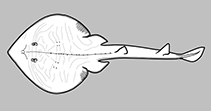
This large shovelnose ray is distinguished by the following characters: suboval disc, short and broadly rounded snout with nostrils partly covered with a large nasal curtain; ridges of small thorns present on mid-line of disc and shoulders; behind interorbital space is an ornate pattern of dark-edged bands without the distinct triangular or diamond-shaped marking (Ref. 114953).
Body shape (shape guide): other; Cross section: flattened.
A benthic species that occurs on continental shelf, mainly found on soft bottoms and seagrasses. Feeds on bottom crustaceans, worms, molluscs and small fishes. Produces litters of 2-5 pups. Maturity size of males at ca. 70 cm TL, females at 89 cm TL; birth size at 21-25 cm TL (Ref. 114953).
Ciclo vitale e comportamento di accoppiamento
Maturità | Riproduzione | Deposizione | Uova | Fecondità | Larve
Last, P.R. and J.D. Stevens, 2009. Sharks and rays of Australia. CSIRO, Australia. 656 p. (Ref. 109431)
Stato della Lista Rossa IUCN (Ref. 130435: Version 2025-2 (Global))
Minaccia per l'uomo
Harmless
Usi umani
Strumenti
Rapporti speciali
Scarica XML
Fonti Internet
Stime basate su modelli
Indice di diversità filogenetica (Fonte Biblio.
82804): PD
50 = 0.7539 [Uniqueness, from 0.5 = low to 2.0 = high].
Bayesian length-weight: a=0.00646 (0.00298 - 0.01397), b=2.98 (2.78 - 3.18), in cm total length, based on LWR estimates for this species & (Sub)family-body (Ref.
93245).
Livello trofico (Fonte Biblio.
69278): 3.7 ±0.6 se; based on size and trophs of closest relatives
Resilienza (Fonte Biblio.
120179): Medio, tempo minimo di raddoppiamento della popolazione 1.4 - 4.4 anni (Preliminary K or Fecundity.).
Vulnerabilità della pesca (Ref.
59153): Very high vulnerability (88 of 100).
🛈
Nutrienti (Ref.
124155): Calcium = 19.7 [4.0, 90.7] mg/100g; Iron = 0.678 [0.174, 1.975] mg/100g; Protein = 19.4 [17.3, 21.3] %; Omega3 = 0.225 [0.101, 0.486] g/100g; Selenium = 31.6 [9.1, 86.6] μg/100g; VitaminA = 6.08 [2.13, 16.80] μg/100g; Zinc = 0.499 [0.251, 0.904] mg/100g (wet weight);