Clasificación / Nombres
Nombres comunes | Sinónimos | Catalog of Fishes(Género, Especie) | ITIS | CoL | WoRMS | Cloffa
>
Gobiiformes (Gobies) >
Gobiidae (Gobies) > Sicydiinae
Etymology: Lentipes: Latin, lens, lentis = slow + Latin, pes = foot (Ref. 45335); ikeae: Named for Miss Ike Rachmatika, the late staff of Ichthyology lab in MZB, in recognition of her work and passion for the freshwater fish of Indonesia.
Eponymy: Ike Rachmatika is a biologist (1982–2010) at the Cibinong Science Centre LIPI, Indonesia. [...] (Ref. 128868), visit book page.
Entorno: milieu / zona climática / rango de profundidad / gama de distribución
Ecología
; agua dulce demersal. Tropical
Asia: Indonesia.
Tamaño / Peso / Edad
Madurez: Lm ? range ? - ? cm
Max length : 3.3 cm SL macho / no sexado; (Ref. 97410); 3.8 cm SL (female)
Descripción breve
Claves de identificación | Morfología | Morfometría
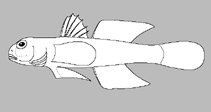
Espinas dorsales (total) : 7; Radios blandos dorsales (total) : 9; Espinas anales: 1; Radios blandos anales: 9. Lentipes ikeae can be disgnosed by the following characters: 16-17 pectoral rays; second dorsal and anal fins with I,9; 23-35 lateral scales; urogenital papilla retractable into a sheath-like groove and without lobes or other expanded tissue; base of the first dorsal fin not reaching (or slightly reaching) the base of the second dorsal fin origin in both sexes; and male with specific body color, with a blue belly, a second dorsal fin with one or two black spots, and a more or less visible bright red band on caudal peduncle (Ref. 97410).
Found in small and rapid mountain stream with a rocky bottom and boulder-strewn at an altitude ranging between 310 and 488 above sea level. Presumed to be amphidromous as the other members of the subfamily (Ref. 97410).
Ciclo vital y comportamiento de apareamiento
Madurez | Reproducción | Puesta | Huevos | Fecundidad | Larva
Keith, P., R. Hadiaty, N. Hubert, F. Busson and C. Lord, 2014. Three new species of Lentipes from Indonesia (Gobiidae). Cybium 38(2):133-146. (Ref. 97410)
Situación en la Lista Roja de la UICN (Ref. 130435: Version 2025-2 (Global))
Amenaza para el ser humano
Harmless
Usos humanos
Herramientas
Informes especiales
Descargar XML
Fuentes de Internet
Estimaciones basadas en modelos
Índice de diversidad filogenética (Referencia
82804): PD
50 = 0.5000 [Uniqueness, from 0.5 = low to 2.0 = high].
Bayesian length-weight: a=0.00389 (0.00180 - 0.00842), b=3.12 (2.94 - 3.30), in cm total length, based on all LWR estimates for this body shape (Ref.
93245).
Resiliencia (Referencia
120179): Alto, población duplicada en un tiempo mínimo inferior a 15 meses (Preliminary K or Fecundity.).
Vulnerabilidad pesquera (Ref.
59153): Low vulnerability (10 of 100).
🛈