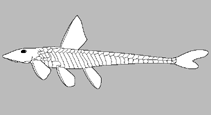
Klassifizierung / Names
Namen | Synonyme | Catalog of Fishes(Gattung, Arten) | ITIS | CoL | WoRMS | Cloffa
>
Siluriformes (Catfishes) >
Loricariidae (Armored catfishes) > Hypostominae
Etymology: Hypostomus: Greek, hypo = under + Greek, stoma = mouth (Ref. 45335); yaku: The specific name is from the Tupi Guarani language, dialect Mbyá, y means water, and raku means hot, warm, in reference to the name of the rio Quente, a warm water river. A noun in apposition.
Umwelt: Milieu / Klimazone / Tiefenbereich / Verbreitungsgebiet
Ökologie
; süßwasser demersal. Tropical; 34°C - ? (Ref. 97842)
South America: Rio Quente, rio Paranaíba drainage, in the upper rio Paraná basin in
central Brazil.
Größe / Gewicht / Alter
Geschlechtsreife: Lm ? range ? - ? cm
Max length : 7.1 cm SL Männchen/unbestimmt; (Ref. 97842)
Kurzbeschreibung
Bestimmungsschlüssel | Morphologie | Morphometrie
Afterflossenweichstrahlen: 5; Wirbelzahl: 27 - 28. Hypostomus yaku can be diagnosed from all congeners by having the five lateral series of plates with hypertrophied odontodes, not aligned in longitudinal rows, more conspicuous on flanks of caudal peduncle of the larger specimens (vs. lateral series of plates without hypertrophied odontodes or with aligned hypertrophied odontodes only along the longitudinal keels) (Ref. 97842).
Body shape (shape guide): elongated.
Facultative air-breathing in the genus (Ref. 126274); The type locality, Rio Quente, has a width of about 3 m and depth of 1.0-1.5 m, moderate flow and bottom with sand, pebbles and rocks. Associated mainly with rocks. Seems to be restricted to warm waters. Collected together with Characidium xanthopterum, Characidium aff. zebra, Knodus moenkhausii, an undescribed species of a putatively new genus of the Characidae, and the exotic Xiphophorus helleri and Oreochromis niloticus (Ref. 97842).
Lebenszyklus und Paarungsverhalten
Geschlechtsreife | Fortpflanzung | Ablaichen | Eier | Fruchtbarkeit | Larven
Martins, F.O., F. Langeani and C.H. Zawadzki, 2014. A new spiny species of Hypostomus Lacépède (Loricariidae: Hypostominae) from thermal waters, upper rio Paraná basin, central Brazil. Neotrop. Ichthyol. (Ref. 97842)
IUCN Rote Liste Status (Ref. 130435: Version 2025-2 (Global))
Bedrohung für Menschen
Harmless
Nutzung durch Menschen
Fischereien: nicht kommerziell
Tools
Zusatzinformationen
Download XML
Internet Quellen
Schätzungen auf der Grundlage von Modellen
Phylogenetischer Diversitätsindex (Ref.
82804): PD
50 = 0.5000 [Uniqueness, from 0.5 = low to 2.0 = high].
Bayesian length-weight: a=0.01585 (0.00726 - 0.03460), b=2.95 (2.78 - 3.12), in cm total length, based on LWR estimates for this Genus-body shape (Ref.
93245).
Widerstandsfähigkeit (Ref.
120179): hoch, Verdopplung der Population dauert weniger als 15 Monate. (Preliminary K or Fecundity.).
Anfälligkeit der Fischerei (Ref.
59153): Low vulnerability (10 of 100).
🛈