Classificação / Nomes
Nomes comuns | Sinónimos | Catalog of Fishes(Género, Espécies) | ITIS | CoL | WoRMS | Cloffa
>
Scombriformes (Mackerels) >
Caristiidae (Manefishes)
Etymology: Platyberyx: Name from the Greek 'platy' meaning flat and Beryx, a genus of beryciform fishes; rhyton: Name from an ancient Greek word which means a widemouth container for fluids, referring to the relatively large mouth of this species.
Ambiente: milieu / zona climática / intervalo de profundidade / gama de distribuição
Ecologia
marinhas batipelágico; intervalo de profundidade ? - 677 m (Ref. 94277). Subtropical
Northwest Pacific, Japan, off Honshu Island.
Tamanho / Peso / Idade
Maturidade: Lm ? range ? - ? cm
Max length : 14.6 cm SL (female)
Descrição breve
Chaves de identificação | Morfologia | Morfometria
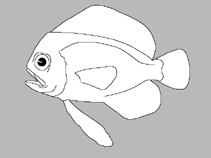
Raios dorsais moles (total) : 30; Raios anais moles: 18; Vértebras: 34. This species is distinguished from P. paucus by having a greater number of dorsal-fin rays (30 vs. 24-26), anal-fin rays (18 vs. 15-16), pectoral-fin rays (18 vs. 16-17), and vertebrae (34 vs. 31); from P. andriashevi by having fewer dorsal-fin rays (30 vs. 36-39), anal-fin rays (18 vs. 19-22), and vertebrae (34 vs. 36-40); and from both species (as well as P. pietschi) by its caudal-fin morphology (ventral caudal spur absent, procurrent rays cylindrical vs. ventral caudal spur present, procurrent rays flattened, bladelike). It differs further from P. pietschi by having a shorter prepectoral length (<32% vs. >39% SL), longer dorsal-fin base (76% vs. 63-69% SL), and larger mouth (upper jaw extending approximately to posterior margin of orbit vs. mid-orbit); from P. opalescens by having a smaller body depth (45% vs. 52-64% SL), shorter head length (31% SL vs. >38% SL), shorter prepectoral length (31% vs. 39-50% SL), and larger mouth (upper jaw extending approximately to posterior margin of orbit vs. mid-orbit); from P. mauli by its gill-raker morphology (narrow, bladelike, with a few bristles concentrated near tip vs. stout, rounded, with many bristles concentrated near tip of raker), dentition (jaw teeth in single row vs. multiple rows), and structure of pharyngeal papillae (dorsal pharyngeal papillae saclike, multifid papillae absent inside mouth vs. multifid papillae near dorsal pharyngeal teeth and throughout mouth) (Ref. 94277).
Body shape (shape guide): short and / or deep; Cross section: compressed.
Ciclo de vida e comportamento de acasalamento
Maturidade | Reprodução | Desova | Ovos | Fecundidade | Larvas
Stevenson, D.E. and C.P. Kenaley, 2013. Revision of the manefish genera Caristius and Platyberyx (Teleostei: Percomorpha: Caristiidae), with description of five new species. Copeia 2013(3):415-434. (Ref. 94277)
Categoria na Lista Vermelha da IUCN (Ref. 130435: Version 2025-2 (Global))
Ameaça para o homem
Harmless
Utilização humana
Ferramentas
Relatórios especiais
Descarregue XML
Fontes da internet
Estimativas baseadas em modelos
Índice de diversidade filogenética (Ref.
82804): PD
50 = 0.5156 [Uniqueness, from 0.5 = low to 2.0 = high].
Bayesian length-weight: a=0.02455 (0.00947 - 0.06362), b=3.00 (2.77 - 3.23), in cm total length, based on LWR estimates for this (Sub)family-body shape (Ref.
93245).
Nível Trófico (Ref.
69278): 3.5 ±0.5 se; based on size and trophs of closest relatives
Vulnerabilidade da pesca (Ref.
59153): Low vulnerability (10 of 100).
🛈