Classification / Noms
Noms communs | Synonymes | Catalog of Fishes(Genre, Espèce) | ITIS | CoL | WoRMS | Cloffa
>
Scombriformes (Mackerels) >
Caristiidae (Manefishes)
Etymology: Platyberyx: Name from the Greek 'platy' meaning flat and Beryx, a genus of beryciform fishes; pietschi: Named for Dr. Theodore W. Pietsch.
Eponymy: Dr Theodore ‘Ted’ Wells Pietsch III (d: 1945) was a professor of ichthyology at the University of Washington, Seattle (1978 onwards) and is an American systematist and evolutionary biologist especially known for his studies of anglerfishes. [...] (Ref. 128868), visit book page.
Environnement : milieu / zone climatique / profondeur / gamme de distribution
Écologie
marin bathypélagique; profondeur 1 - 750 m (Ref. 94277). Tropical
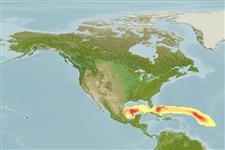
Central Pacific, Southwestern Pacific and Northwestern Atlantic.
Taille / Poids / Âge
Maturité: Lm ? range ? - ? cm
Max length : 9.3 cm SL mâle / non sexé; (Ref. 94277)
Description synthétique
Clés d'identification | Morphologie | Morphométrie
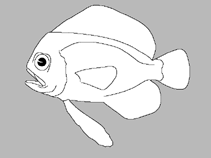
Rayons mous dorsaux (Total) : 30 - 31; Rayons mous anaux: 18 - 19; Vertèbres: 33 - 35. This species is distinguished from its congeners by having an anteriorly directed hook-like process on the third posteriormost ventral procurrent caudal ray; differs from P. paucus by having greater number of dorsal-fin rays (30-31 vs. 24-26), anal-fin rays (18-19 vs. 15-16), pectoral-fin rays (17-18 vs. 16-17), and vertebrae (33-35 vs. 31); differs from P. andriashevi by having fewer dorsal-fin rays (30-31 vs. 31-37), anal-fin rays (18-19 vs. 19-22), and vertebrae (33-35 vs. 36-39); differs further from P. opalescens by having small bristles and larger spikes on the gill rakers (vs. small bristles only), and from P. rhyton and P. mauli by the greater prepectoral (>39% SL vs. <36% SL) and prepelvic (>36% SL vs. <33% SL) length, shorter dorsal-fin base (<70% SL vs. >75% SL), and smaller mouth (upper jaw extending to midorbit vs. posterior margin of orbit) (Ref. 94277).
Body shape (shape guide): short and / or deep; Cross section: compressed.
Cycle de vie et comportement reproducteur
Maturité | Reproduction | Frai | Œufs | Fécondité | Larves
Stevenson, D.E. and C.P. Kenaley, 2013. Revision of the manefish genera Caristius and Platyberyx (Teleostei: Percomorpha: Caristiidae), with description of five new species. Copeia 2013(3):415-434. (Ref. 94277)
Statut dans la liste rouge de l'IUCN (Ref. 130435: Version 2025-2 (Global))
Menace pour l'homme
Harmless
Utilisations par l'homme
Outils
Articles particuliers
Télécharger en XML
Sources Internet
Estimations basées sur des modèles
Température préférée (Réf.
123201): 13.2 - 23.6, mean 19 °C (based on 13 cells).
Indice de diversité phylogénétique (Réf.
82804): PD
50 = 0.5156 [Uniqueness, from 0.5 = low to 2.0 = high].
Bayesian length-weight: a=0.02455 (0.00947 - 0.06362), b=3.00 (2.77 - 3.23), in cm total length, based on LWR estimates for this (Sub)family-body shape (Ref.
93245).
Niveau trophique (Réf.
69278): 3.4 ±0.5 se; based on size and trophs of closest relatives
Vulnérabilité de la pêche (Ref.
59153): Low vulnerability (10 of 100).
🛈