Klassifizierung / Names
Namen | Synonyme | Catalog of Fishes(Gattung, Arten) | ITIS | CoL | WoRMS | Cloffa
>
Characiformes (Characins) >
Characidae (Characins; tetras) > Cheirodontinae
Etymology: Serrapinnus: Latin, serran, serranus, saw and a fish of genus Serranus + Latin, pinna = spiny, thorn (Ref. 45335); tocantinensis: The name is in reference to the restricted geographic distribution of the species to the rio Tocantins-Araguaia basin. A noun in apposition.
Umwelt: Milieu / Klimazone / Tiefenbereich / Verbreitungsgebiet
Ökologie
; süßwasser benthopelagisch. Tropical
South America: Rio Tocantins-Araguaia basin in Brazil.
Größe / Gewicht / Alter
Geschlechtsreife: Lm ? range ? - ? cm
Max length : 4.0 cm SL Männchen/unbestimmt; (Ref. 96959)
Kurzbeschreibung
Bestimmungsschlüssel | Morphologie | Morphometrie
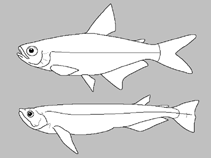
Rückenflossenstacheln (insgesamt) : 10 - 11. Serrapinnus tocantinensis is distinguisged from its congeners by the elongation of the unbranched dorsal and pelvic-fin rays into filaments in mature males. It differs further from S. sterbai by the absence of a continuous mid-lateral black stripe extending from the opercular region to the caudal-peduncle spot. It can be separated from other congeners by having the following characters: 9 to 11 cusps in the premaxillary teeth (vs. 5 in S. microdon and S. potiguar, 7 in S. aster, 7 to 9 in S. calliurus, S. heterodon, S. kriegi, S. micropterus, S. notomelas and S. piaba and 10 to 12 in S. gracilis and S. littoris); dentary teeth without expanded cusps forming a sharp cutting edge (vs. dentary teeth with expanded cusps forming a sharp cutting edge in S. heterodon); hyaline dorsal fin (vs. with a proximal black blotch in S. notomela; and black spot absent on the posteroventral region of the abdomen (vs. present in S. kriegi) (Ref. 96959).
Body shape (shape guide): elongated.
Lebenszyklus und Paarungsverhalten
Geschlechtsreife | Fortpflanzung | Ablaichen | Eier | Fruchtbarkeit | Larven
Malabarba, L.R. and F.C. Jerep, 2014. Review of the species of the genus Serrapinnus Malabarba, 1998 (Teleostei: Characidae: Cheirodontinae) from the rio Tocantins-Araguaia basin, with description of three new species. Zootaxa 3847(1):057-079. (Ref. 96959)
IUCN Rote Liste Status (Ref. 130435: Version 2025-2 (Global))
Bedrohung für Menschen
Harmless
Nutzung durch Menschen
Fischereien: nicht kommerziell
Tools
Zusatzinformationen
Download XML
Internet Quellen
Schätzungen auf der Grundlage von Modellen
Phylogenetischer Diversitätsindex (Ref.
82804): PD
50 = 0.5000 [Uniqueness, from 0.5 = low to 2.0 = high].
Bayesian length-weight: a=0.01072 (0.00446 - 0.02572), b=3.07 (2.88 - 3.26), in cm total length, based on LWR estimates for this Genus-body shape (Ref.
93245).
Trophische Ebene (Ref.
69278): 2.5 ±0.5 se; based on size and trophs of closest relatives
Anfälligkeit der Fischerei (Ref.
59153): Low vulnerability (10 of 100).
🛈