>
Gobiiformes (Gobies) >
Gobiidae (Gobies) > Gobiinae
Etymology: Trimma: Greek, trimma, -atos = something crushed (Ref. 45335); insularum: Name from Latin ‘insularis’ meaning ‘of an island’; referring to the distribution of the species, which is apparently confined to the Cocos (Keeling) Islands.
Environnement : milieu / zone climatique / profondeur / gamme de distribution
Écologie
marin récifal; profondeur 1 - 31 m (Ref. 100726). Tropical
Eastern Indian Ocean: Cocos (Keeling) Islands.
Taille / Poids / Âge
Maturité: Lm ? range ? - ? cm
Max length : 2.8 cm SL mâle / non sexé; (Ref. 100726)
Description synthétique
Clés d'identification | Morphologie | Morphométrie
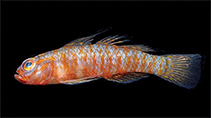
A species of Trimma with a vertically-sided, ‘U’-shaped interorbital trench and well developed postorbital trench, scales centred on the predorsal midline usually absent (although there may be 1–3 scales anteriorly in the midline, with a narrowly triangular naked area in front of the first dorsal spine); second dorsal spine elongated in adults (>20 mm SL), and may reach posteriorly to the dorsal procurrent caudal fin rays; third spine somewhat elongated, often extending beyond the spine of the second dorsal fin; usually 10 dorsal, 9 anal and 17–19 pectoral-fin rays, the latter with 5–12 branched rays at the middle of the fin, fifth pelvic ray usually branched once and about half the length of the fourth (47–64%); 18–20 total gill rakers on the first gill arch; and bony interorbital width less than half pupil-diameter. When freshly collected, this species is immediately distinguishable from all other described species of Trimma by the broad oblique yellow stripe across the cheek (Ref. 100726).
Cycle de vie et comportement reproducteur
Maturité | Reproduction | Frai | Œufs | Fécondité | Larves
Winterbottom, R. and D.F. Hoese, 2015. A revision of the Australian species of Trimma (Actinopterygii, Gobiidae), with descriptions of six new species and redescriptions of twenty-three valid species. Zootaxa 3934(1):001-102. (Ref. 100726)
Statut dans la liste rouge de l'IUCN (Ref. 130435: Version 2025-2 (Global))
Menace pour l'homme
Harmless
Utilisations par l'homme
Pêcheries: sans intérêt
Outils
Articles particuliers
Télécharger en XML
Sources Internet
Estimations basées sur des modèles
Indice de diversité phylogénétique (Réf.
82804): PD
50 = 0.5000 [Uniqueness, from 0.5 = low to 2.0 = high].
Bayesian length-weight: a=0.01023 (0.00477 - 0.02194), b=3.01 (2.83 - 3.19), in cm total length, based on LWR estimates for this (Sub)family-body shape (Ref.
93245).
Résilience (Réf.
120179): Haut, temps minimum de doublement de population inférieur à 15 mois (Preliminary K or Fecundity.).
Vulnérabilité de la pêche (Ref.
59153): Low vulnerability (10 of 100).
🛈