Clasificación / Nombres
Nombres comunes | Sinónimos | Catalog of Fishes(Género, Especie) | ITIS | CoL | WoRMS | Cloffa
>
Cichliformes (Cichlids, convict blennies) >
Cichlidae (Cichlids) > Cichlinae
Etymology: Herichthys: Greek, eri = very, a lot + Greek, ichthys = fish (Ref. 45335); tepehua: Name derived from the Nahuatl language meaning 'the ones who possess the mountains.' It refers to the remaining, as of the 1990 Mexico census, 10,573 members of the indigenous Tepehua ethnic group and their language, spoken in eastern Mexico in the states of Veracruz, Hidalgo, and Puebla.
Entorno: milieu / zona climática / rango de profundidad / gama de distribución
Ecología
; agua dulce bentopelágico. Tropical
Central America: Tuxpan/Pantepec, Cazones, Tecolutla, Tenixtepec and Solteros river systems in Mexico.
Tamaño / Peso / Edad
Madurez: Lm ? range ? - ? cm
Max length : 13.8 cm SL macho / no sexado; (Ref. 99935)
Descripción breve
Claves de identificación | Morfología | Morfometría
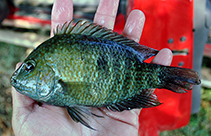
Espinas dorsales (total) : 15 - 17; Radios blandos dorsales (total) : 10 - 12; Espinas anales: 4 - 6; Radios blandos anales: 8 - 10. Herichthys tepehua is distinguished from H. deppii by having longer head (mean 37% SL, SD 2% SL vs. mean 35% SL, SD 1% SL), shorter distance from the anal fin origin to the hypural base (mean 39% SL, SD 2% SL vs. 42% SL , SD 1% SL), a larger eye (mean 26% HL, SD 3% vs. mean 24% HL, SD 2% HL). It can be diagnosed from H. carpintis in that it has a longer anal fin origin-hypural base distance (mean 39%, SD 2% vs. mean 38%, SD 2%) in SL; deeper cheeks (mean 32%, SD 4% vs. mean 28%, SD 4%) and longer snout (mean 39%, SD 4% vs. mean 37%, SD 3%) all in HL. It also differs from other congeners by the following autapomorphies: 2 conspicuous blue/ green parallel markings on the sides of the cheeks extending from the lip fold to the orbit of the eye. Ground color is blue-green. It shares with H. deppii the absence of iridescent spots/pearls on the body (Ref. 99935).
Ciclo vital y comportamiento de apareamiento
Madurez | Reproducción | Puesta | Huevos | Fecundidad | Larva
De la Maza-Benignos, M., C.P. Ornelas-García, M.d.L. Lozano-Vilano, M.E. García-Ramírez and I. Doadrio, 2015. Phylogeographic analysis of genus Herichthys (Perciformes: Cichlidae), with descriptions of Nosferatu new genus and H. tepehua n. sp. Hydrobiologia 748:201-231. (Ref. 99935)
Situación en la Lista Roja de la UICN (Ref. 130435: Version 2025-2 (Global))
Amenaza para el ser humano
Harmless
Usos humanos
Herramientas
Informes especiales
Descargar XML
Fuentes de Internet
Estimaciones basadas en modelos
Índice de diversidad filogenética (Referencia
82804): PD
50 = 0.5001 [Uniqueness, from 0.5 = low to 2.0 = high].
Bayesian length-weight: a=0.01445 (0.00665 - 0.03141), b=3.08 (2.90 - 3.26), in cm total length, based on LWR estimates for this (Sub)family-body shape (Ref.
93245).
Nivel trófico (Referencia
69278): 3.4 ±0.1 se; based on size and trophs of closest relatives
Resiliencia (Referencia
120179): Alto, población duplicada en un tiempo mínimo inferior a 15 meses (Preliminary K or Fecundity.).
Vulnerabilidad pesquera (Ref.
59153): Low vulnerability (10 of 100).
🛈