>
Siluriformes (Catfishes) >
Callichthyidae (Callichthyid armored catfishes) > Corydoradinae
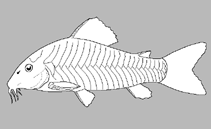
Etymology: lacrimostigmata: Derived from the Latin words lacrĭma (meaning tear) and stigmata (meaning marks, plural of stigma), in allusion to the diffuse dark stripe between corner of mouth and anterior margin of orbit and the drop-shaped dark blotch on the posterior portion of infraorbital 1, which seem to be tears. A noun in apposition.
Milieu: milieu / Klimaatzone / Diepte / verspreidingsgebied
Ecologie
; zoet water demersaal. Tropical
South America: Rio Ivaí basin, upper rio Paraná basin in Brazil.
Grootte / Gewicht / Leeftijd
Maturiteit: Lm ? range ? - ? cm
Max length : 3.8 cm SL mannelijk / geslacht onbekend; (Ref. 126020); max. gepubliceerd gewicht: 1.58 g (Ref. 126020)
Korte beschrijving
Determinatiesleutels | Morfologie | Morfometrie
Dorsale stekels (totaal) : 2; Dorsale zachte stralen (totaal) : 8 - 9; Anale zachte stralen: 7; Wervels: 23. Corydoras lacrimostigmata can be diagnosed from other congeners, except C. carlae, C. ehrhardti, C. flaveolus, C. longipinnis, C. nattereri, C. paleatus, and C. vittatus, in having three nasal pores (vs. two). It differs from C. carlae, C. ehrhardti, C. longipinnis, C. nattereri, C. paleatus, and C. vittatus in having four to six small rounded black blotches along the midline of flank (vs. midline of flank with three large black blotches in C. carlae, C. ehrhardti, C. longipinnis, and C. paleatus; longitudinal dark stripe in C. nattereri; and anterior portion spotted and posterior portion with posterior margin of plates blackened, forming a rough dark stripe in some specimens of C. vittatus). It is distinguished from C. flaveolus in having 16-19 serrations on posterior margin of pectoral-fin spine (vs. 27-36) and 7-10 on posterior margin of dorsal-fin spine (vs. 15-22); and simple serrations on posterior margin of pectoral-fin spine (vs. presence of simple and bifid serrations) (Ref. 95501).
Body shape (shape guide): elongated.
Facultative air-breathing (Ref. 126274)
Levenscyclus en paargedrag
Maturiteit | Voortplanting | Paaien | Eieren | Fecunditeit | Larven
Tencatt, L.F.C., M.R. Britto and C.S. Pavanelli, 2014. A new species of Corydoras Lacépède, 1803 (Siluriformes: Callichthyidae) from the upper rio Paraná basin, Brazil. Neotrop. Ichthyol. 12(1):89-96. (Ref. 95501)
Status op de Rode Lijst van het IUCN (Ref. 130435: Version 2025-2 (Global))
Gevaar voor de mens
Harmless
Gebruik door de mens
Tools
Speciale rapporten
Download XML
Internetbronnen
Schattingen op basis van modellen
Fylogenetische diversiteitsindex (Ref.
82804): PD
50 = 0.5000 [Uniqueness, from 0.5 = low to 2.0 = high].
Bayesian length-weight: a=0.00741 (0.00287 - 0.01912), b=3.14 (2.92 - 3.36), in cm total length, based on LWR estimates for this (Sub)family-body shape (Ref.
93245).
Trofisch niveau (Ref.
69278): 3.0 ±0.4 se; based on size and trophs of closest relatives
Weerstandsvermogen (Ref.
120179): Hoog, minimale populatieverdubbelingstijd minder dan 15 maanden (Preliminary K or Fecundity.).
Kwetsbaarheid van de visserij (Ref.
59153): Low vulnerability (10 of 100).
🛈