Classificazione / Nomi
Nomi Comuni | Sinonimi | Catalog of Fishes(Genere, Specie) | ITIS | CoL | WoRMS | Cloffa
>
Siluriformes (Catfishes) >
Trichomycteridae (Pencil or parasitic catfishes) > Trichomycterinae
Etymology: huachi: The specific name is in reference to the type locality of the species, Río Huertas de Huachi. A noun in apposition.
Eponymy: Dr Silvina Adela Menu-Marque is an Argentinean zoologist at the Department of Biological Sciences, University of Buenos Aires, where her doctorate was awarded (2002). [...] A toponym, referring to the type locality; the Río Huerta de Huachi in Argentina. (Ref. 128868), visit book page.
Ambiente: milieu / zona climatica / distribuzione batimetrica / gamma di distribuzione
Ecologia
; acqua dolce demersale. Subtropical; 20°C - ? (Ref. 95056)
South America: Río Huerta de Huachi in Argentina.
Dimensione / Peso / Età
Maturità: Lm ? range ? - ? cm
Max length : 3.0 cm SL maschio/sesso non determinato; (Ref. 95056)
Breve descrizione
Chiavi di identificazione | Morfologia | Morfometria
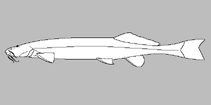
Raggi dorsali molli (totale) : 11 - 13; Vertebre: 37 - 39. Distinguished from Silvinichthys bortayro by the following characters: triangular shape of the head from a dorsal view (vs. more rectangular); 8-11 (vs. 2-4) opercular odontodes and 21-28 (vs. 9-12) interopercle odontodes apparent in cleared and stained specimens; 11-13 dorsal-fin rays (vs. 9); caudal-peduncle depth 8.8-10.9% SL (vs. 8.0-8.3% SL); snout length 43.3-61.9% HL (vs. 38.2-40.5% HL); head with broadly separated, dark, marmorated bands of pigmentation and body with a more concentrated, but still diffuse, patch of darker pigmentation overlying the dorsal surface of the cranium and the dorsal portions of the pectoral girdle (vs. lacks the dark marmorated pigmentation in larger individuals); absence of dark midlateral stripe on the caudal peduncle at all sizes (vs. presence of a dark midlateral stripe in mid-sized specimens). Differs from S. gualcamayo by the caudal peduncle length 19.3-21.5 % SL (vs. 22.0-23.9% ) and the insertion point of the first proximal dorsal-fin pterygiophore is posterior to the neural spine of vertebra 21 (vs. 22); from S. leoncitensis by having 37-39 vertebrae (vs. 40), 16-18 ribs on each side (vs. 20); 6-7 pectoral-fin rays (vs. 8), body depth 12.6-16.5 % SL (vs. 8.4-12.2% SL), caudal-peduncle depth 8.8-10.9% SL (vs. 6.6-8.6% SL), and the insertion point of the first proximal dorsal-fin pterygiophore posterior to the neural spine of vertebra 21 (vs. 23); and from S. mendozensis by the absence of pelvic fin and pelvic-fin girdle (vs. presence) and 21-28 (vs. 30-42) interopercle odontodes apparent in cleared and stained specimens (Ref. 95056).
Body shape (shape guide): elongated.
The type locality is a clear water stream with depth of 0.06-0.30 m and width of 1.5-2.0 m over a rock and cobble bottom, water temperature of 19.7°C and surrounded by limited riparian vegetation. Nocturnally active with individuals observed swimming during the night and hiding among rocks on the stream bed during the day. Stomach contents of 2 specimens consisted of dipteran larvae (Chironomidae) and sand, suggesting that this species feeds on autochthonous benthic macroinvertebrates. Spawns before April since observations during that month in 2009 revealed that its population at the sampling site contained larger numbers of juveniles than adults (Ref. 95056).
Ciclo vitale e comportamento di accoppiamento
Maturità | Riproduzione | Deposizione | Uova | Fecondità | Larve
Fernández, L., E.A. Sanabria, L.B. Quiroga and R.P. Vari, 2014. A new species of Silvinichthys (Siluriformes, Trichomycteridae) lacking pelvic fins from mid-elevation localities of the southern Andes, with comments on the genus. J. Fish Biol. 84(2):372-382. (Ref. 95056)
Stato della Lista Rossa IUCN (Ref. 130435: Version 2025-2 (Global))
Minaccia per l'uomo
Harmless
Usi umani
Pesca: di nessun interesse
Strumenti
Rapporti speciali
Scarica XML
Fonti Internet
Stime basate su modelli
Indice di diversità filogenetica (Fonte Biblio.
82804): PD
50 = 0.5078 [Uniqueness, from 0.5 = low to 2.0 = high].
Bayesian length-weight: a=0.00759 (0.00337 - 0.01709), b=3.00 (2.81 - 3.19), in cm total length, based on LWR estimates for this (Sub)family-body shape (Ref.
93245).
Livello trofico (Fonte Biblio.
69278): 3.1 ±0.4 se; based on size and trophs of closest relatives
Vulnerabilità della pesca (Ref.
59153): Low vulnerability (10 of 100).
🛈