Classificazione / Nomi
Nomi Comuni | Sinonimi | Catalog of Fishes(Genere, Specie) | ITIS | CoL | WoRMS | Cloffa
>
Percopsiformes (Trout-perches, pirate perches and cavefishes) >
Amblyopsidae (Cavefishes)
Etymology: Amblyopsis: Greek, amblys = darkness + Greek, ops = shape (Ref. 45335); hoosieri: The specific name is in reference to this species being from the state of Indiana and also in reference to Indiana University, where biologist Carl H. Eigenmann was a Professor of Zoology and studied blind cave vertebrates, including populations of Amblyopsis hoosieri in Lawrence County. The name is derived from the proper noun Hoosier. The senior author of the manuscript is an avid fan of Indiana Hoosier basketball while the first author is an alumni of the
University of Michigan.
Eponymy: This sounds like an eponym but is in reality a sort of toponym. Hoosier is the nickname given to residents of the state of Indiana (where this cavefish occurs). (Ref. 128868), visit book page.
Ambiente: milieu / zona climatica / distribuzione batimetrica / gamma di distribuzione
Ecologia
; acqua dolce benthopelagico. Temperate
North America: Indiana, USA.
Dimensione / Peso / Età
Maturità: Lm ? range ? - ? cm
Max length : 8.2 cm SL maschio/sesso non determinato; (Ref. 96073)
Breve descrizione
Chiavi di identificazione | Morfologia | Morfometria
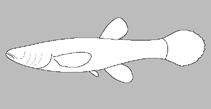
Raggi dorsali molli (totale) : 8 - 11; Raggi anali molli: 8 - 10; Vertebre: 29 - 30. Differs from its only congener, Amblyopsis pelaea by having the following characters: body more plump, fleshy and rounded (vs. sculpted, thin) with Bibendum-like wrinkles along myomeres (vs. tight skin); pectoral fins rounder (vs. pointed); and mechansensory papillae on the body and caudal fin reduced in size and less elevated on the skin (vs. conspicuous) (Ref. 96073).
Body shape (shape guide): elongated.
Inhabits mainly larger cave streams at or near the water table where it has been observed in slow flowing pools at depths as shallow as 0.1 m to > 2 m deep. Reported to feed on copepods, isopods, and amphipods but larger individuals prey upon small crayfish. Spawning probably takes place during high water levels from February through April. Females incubate eggs in their branchial cavities until hatching and continue to care for fry until yolk reserves are depleted 4-5 months later. Likely attains sexual maturity in 3-4 years (Ref. 96073).
Ciclo vitale e comportamento di accoppiamento
Maturità | Riproduzione | Deposizione | Uova | Fecondità | Larve
Chakrabarty, P., J.A. Prejean and M.L. Niemiller, 2014. The hoosier cavefish, a new and endangered species (Amblyopsidae, Amblyopsis) from the caves of southern India. Zookeys 412:41-57. (Ref. 96073)
Stato della Lista Rossa IUCN (Ref. 130435: Version 2025-2 (Global))
Minaccia per l'uomo
Harmless
Usi umani
Strumenti
Rapporti speciali
Scarica XML
Fonti Internet
Stime basate su modelli
Indice di diversità filogenetica (Fonte Biblio.
82804): PD
50 = 0.6331 [Uniqueness, from 0.5 = low to 2.0 = high].
Bayesian length-weight: a=0.00389 (0.00180 - 0.00842), b=3.12 (2.94 - 3.30), in cm total length, based on all LWR estimates for this body shape (Ref.
93245).
Livello trofico (Fonte Biblio.
69278): 3.6 ±0.5 se; based on size and trophs of closest relatives
Resilienza (Fonte Biblio.
120179): Medio, tempo minimo di raddoppiamento della popolazione 1.4 - 4.4 anni (Preliminary K or Fecundity.).
Vulnerabilità della pesca (Ref.
59153): Low vulnerability (10 of 100).
🛈