Classificazione / Nomi
Nomi Comuni | Sinonimi | Catalog of Fishes(Genere, Specie) | ITIS | CoL | WoRMS | Cloffa
>
Cichliformes (Cichlids, convict blennies) >
Cichlidae (Cichlids) > Pseudocrenilabrinae
Etymology: Haplochromis: Greek, Haploos = single + Greek, chromis = a fish, perhaps a perch (Ref. 45335); vanheusdeni: The species name vanheusdeni honours the Dutchman Hans van Heusden, one of the most dedicated cichlid naturalists, who has documented for the first time with underwater photographs and videos as well as with aquarium observations the behaviour and ecology of this species and many other cichlids all over Africa (Ref. 97348).
Eponymy: Hans van Heusden (d: 1957) is a Dutch aquarist, angler and photographer (including underwater), who currently works for a construction company. [...] (Ref. 128868), visit book page.
Ambiente: milieu / zona climatica / distribuzione batimetrica / gamma di distribuzione
Ecologia
; acqua dolce benthopelagico. Tropical
Africa: Great Ruaha River basin, Tanzania (Ref. 97348).
Dimensione / Peso / Età
Maturità: Lm ? range ? - ? cm
Max length : 8.4 cm SL maschio/sesso non determinato; (Ref. 97348)
Breve descrizione
Chiavi di identificazione | Morfologia | Morfometria
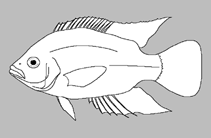
Spine dorsali (totale) : 16 - 18; Raggi dorsali molli (totale) : 8 - 10; Spine anali: 3; Raggi anali molli: 6 - 8; Vertebre: 28 - 29. Diagnosis: Haplochromis vanheusdeni can be distinguished from all species of the genus Orthochromis except O. torrenticola by the presence of egg spots on the anal fin in both males and females vs. no egg spots, and by hypuralia 1 and 2 and hypuralia 3 and 4 either clearly separated or separated by a clearly visible seam vs. never fused into a single seamless unit (Ref. 97348). It can be distinguished from Orthochromis kalungwishiensis, O. kasuluensis, O. luongoensis and O. torrenticola by having fewer caudal vertebrae, 14-16 vs. 17; and fewer total vertebrae, 28-30 vs. 31-33; from O. rugufuensis and O. uvinzae by having fewer total vertebrae, 28-30 vs. 31-33, and dorsal fin spines, 16-17 vs. 19-20; from O. polyacanthus and O. rubrolabialis by having fewer inner series of teeth in the lower jaw, 1-2 vs. 3-5, and fewer dorsal fin spines, 16-17 vs. 18-20; and from O. malagaraziensis by having more scales between the lateral line and the dorsal fin origin, 3-4 vs. 5-6; from O. machadoi, O. mazimeroensis, O. stormsi and Haplochromis bakongo by having a scaleless chest vs. a scaled chest; from O. mosoensis by having small cycloid scaled on the belly vs. no scales; from O. luichensis by the different stripe and bar patterns on the head ; from Schwetzochromis neodon by the presence of lachrymal stripes and fewer inner teeth rows in both jaws, 1-3 vs. 4-6; from Haplochromis snoeksi by having fewer scales on the horizontal line, 26-29 vs. 30-31, and on upper lateral line, 20-22 vs. 23, and in having fewer caudal vertebrae, 14-16 vs. 17 (Ref. 97348).
Body shape (shape guide): fusiform / normal.
Haplochromis vanheusdeni is a benthic-rheophilic fish, mostly found among stones over sand and debris in smaller streams or larger rivers (Ref. 97348). Underwater observations suggest a mixed diet of sand-and-debris dwelling organisms and drifting food particles (Ref. 98348). Large males and brood-caring females defend small territories, sometimes centred around a whole under stones; it is a maternal mouthbrooder (Ref. 97348).
Ciclo vitale e comportamento di accoppiamento
Maturità | Riproduzione | Deposizione | Uova | Fecondità | Larve
Large males and brood-caring females defend small territories, sometimes centred around a whole under stones; it is a maternal mouthbrooder (Ref. 97348).
Schedel, F.D.B., J.P. Friel and U.K. Schliewen, 2014. Haplochromis vanheusdeni, a new haplochromine cichlid species from the Great Ruaha River drainage, Rufiji basin, Tanzania. Spixiana 37(1):135-149. (Ref. 97348)
Stato della Lista Rossa IUCN (Ref. 130435: Version 2025-2 (Global))
Minaccia per l'uomo
Harmless
Usi umani
Strumenti
Rapporti speciali
Scarica XML
Fonti Internet
Stime basate su modelli
Indice di diversità filogenetica (Fonte Biblio.
82804): PD
50 = 0.5000 [Uniqueness, from 0.5 = low to 2.0 = high].
Bayesian length-weight: a=0.00389 (0.00180 - 0.00842), b=3.12 (2.94 - 3.30), in cm total length, based on all LWR estimates for this body shape (Ref.
93245).
Livello trofico (Fonte Biblio.
69278): 3.3 ±0.4 se; based on size and trophs of closest relatives
Resilienza (Fonte Biblio.
120179): Alto, tempo minimo di raddoppiamento della popolazione meno di 15 mesi (Preliminary K or Fecundity.).
Vulnerabilità della pesca (Ref.
59153): Low vulnerability (10 of 100).
🛈