Ikan bertulang rawan (sharks and rays) >
Rhinopristiformes (Shovelnose rays) >
Rhinobatidae (Guitarfishes)
Etymology: Rhinobatos: Greek, rhinos = nose + Greek, batis, -idos = a ray (Raja sp.) (Ref. 45335); whitei: Named for Dr. William White for his contributions to the taxonomic and biological knowledge of sharks and rays of the Western Central Pacific.
Eponymy: Dr William Toby White (d: 1977) is an Australian ichthyologist whose particular interests are speciation and biodiversity of sharks and rays and fishery management in developing countries. [...] (Ref. 128868), visit book page.
Lingkungan: lingkungan / zona iklim / kisaran kedalaman / jangkauan distribusi
Ekologi
laut dasar (demersal). Tropical; 13°N - 8°N, 120°E - 125°E (Ref. 114953)
Western Pacific: Philippines.
Ukuran / Berat / umur
Kematangan: Lm ? range ? - ? cm
Max length : 72.0 cm TL jantan/; (Ref. 97528); 84.4 cm TL (female)
deskripsi pendek
Kunci identifiaksi (pengenalan) | Morfologi | Morfometrik
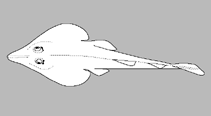
This species is distinguished by the following set of adult characters: wedge-shaped disc with moderately concave anterior snout margin, width 31-35% TL, disc length 1.3-1.4 times width; snout length 3.0-3.4 times interspiracular distance, 3.9-5.2 times interorbital width; orbit medium-sized, 1.4-1.7 times spiracle length; notrils weakly oblique, length 1.3-1.6 times internarial distance; preoral length 6.8-7.8 times internarial distance; anterior nasal flaps which are penetrating slightly into internarial space but well separated at their insertion; posterior nasal flaps broad; spiracles large with two folds, outermost fold distinctly longer than inner fold; ridges of rostral cartilage almost parallel, converging slightly anteriorly but not constricted medially; anterior cartilage is subtriangular; distance between fifth gill slits 3.0-3.4 times in ventral head length; prebranchial sensory pore patch distinct, extending to just behind first gill slit; distinct postscapular sensory canal, with exposed lateral pores, grooved; thorn patches on supraorbit, nuchal and scapular regions, and dorsal midline rudimentary, non-conspicuous; in males, pelvic-fin inner margin longer than its base and in females subequal; interdorsal distance 2.6-3.2 times length of first dorsal-fin base; dorsal caudal margin 2.1-2.6 times preventral margin; upper jaw with ca. 65-92 tooth rows; post-synarcual centra, 173-179; nasal lamellae, 50-53; in adults dorsal surface brownish, covered with diffuse orange and dusky blotches, and indistinct pale spots; melanophores pronounced on dorsal surface, and dorsal fins largely pale anteriorly, darker posteriorly with a blackish blotch above the free rear tip when fresh (Ref. 97528).
Cross section: flattened.
Males mature at ca. 56 cm TL, females slightly larger. Unknown life history (Ref. 114953).
Siklus hidup dan perilaku kawin
Kematangan | Reproduksi, perkembang biakan | Pemijahan | telur-telur | Fekunditas | Larva
Last, P.R., S. Corrigan and G. Naylor, 2014. Rhinobatos whitei, a new shovelnose ray (Batoidea: Rhinobatidae) from the Philippine Archipelago. Zootaxa 3872(1):31-47. (Ref. 97528)
Status IUCN Red List (Ref. 130435: Version 2025-2 (Global))
ancaman kepada manusia
Harmless
penggunaan manusia
Perikanan: komersial
Alat, peralatan
laporan khas
muat turun XML
Sumber internet
Estimasi berdasarkan model
Indeks keanekaragaman filogenetik (Acuan
82804): PD
50 = 0.5000 [Uniqueness, from 0.5 = low to 2.0 = high].
Bayesian length-weight: a=0.00295 (0.00150 - 0.00581), b=3.13 (2.96 - 3.30), in cm total length, based on LWR estimates for this (Sub)family-body shape (Ref.
93245).
Tingkat Trofik (Acuan
69278): 3.7 ±0.4 se; based on size and trophs of closest relatives
Daya lenting (Acuan
120179): Rendah, Waktu penggandaan populasi minimum 4.5 - 14 tahun (Preliminary low fecundity).
Kerentanan Penangkapan Ikan (Ref.
59153): Moderate to high vulnerability (54 of 100).
🛈