Elasmobranchii (tubarões e raias) (sharks and rays) >
Pristiophoriformes (Saw sharks) >
Pristiophoridae (Saw sharks)
Etymology: Pristiophorus: pristio-, presumably derived from prio (Gr.), to saw, but treated here as a noun (a saw); phorus, from phoreus (Gr.), bearer or carrier, referring to saw-like snout (note also that pristis is Greek for sawfish) (See ETYFish); lanae: In honor of “shark enthusiast” Lana Ebert (the senior author’s niece) on the occasion of her graduation from the University of San Francisco (her brother is similarly honored; see Rhinobatos austini, Rhinobatidae) (See ETYFish).
Eponymy: Lana Ebert is a marine biologist, shark enthusiast and the niece of senior author David Ebert. [...] (Ref. 128868), visit book page.
Ambiente: milieu / zona climática / intervalo de profundidade / gama de distribuição
Ecologia
marinhas pelagic-neritic; intervalo de profundidade 29 - 593 m (Ref. 94800). Tropical
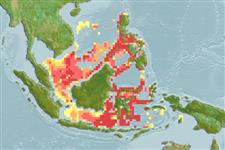
Western Pacific: Philippines.
Tamanho / Peso / Idade
Maturidade: Lm ? range ? - ? cm
Max length : 66.9 cm TL macho/indeterminado; (Ref. 94800); 90.0 cm TL (female)
Descrição breve
Chaves de identificação | Morfologia | Morfometria
This slender bodied five-gilled sawshark is distinguished from its congeners by the following combination of characters: a narrow, relatively long rostrum, with a pre-oral length 27.5-30.6% TL; pre-barbel length 51-55% of pre-oral length; rostral width at nostrils 4.8-6.1 times pre-orbital length. Barbels located closer to the mouth than to rostral tip. First dorsal fin originates posterior to free rear tip of pectoral fin; lateral dermal denticles are unicuspidate, mostly flat, and imbricated; color uniform dark brown above, lighter below; no bars, blotches or other distinctive markings (Ref. 94800).
Body shape (shape guide): other (see remarks); Cross section: oval.
Inhabits upper continental slopes in tropical waters (Ref. 94800).
Ciclo de vida e comportamento de acasalamento
Maturidade | Reprodução | Desova | Ovos | Fecundidade | Larvas
Ebert, D.A. and H.A. Wilms, 2013. Pristiophorus lanae sp. nov., a new sawshark species from the Western North Pacific, with comments to the genus Pristiophorus Müller & Henle, 1837 (Chondrichthyes: Pristophoridae). Zootaxa 3752(1):086-100. (Ref. 94800)
Categoria na Lista Vermelha da IUCN (Ref. 130435: Version 2025-2 (Global))
Ameaça para o homem
Harmless
Utilização humana
Ferramentas
Relatórios especiais
Descarregue XML
Fontes da internet
Estimativas baseadas em modelos
Temperatura preferida (Ref.
123201): 12.6 - 23.8, mean 18 °C (based on 27 cells).
Índice de diversidade filogenética (Ref.
82804): PD
50 = 0.5098 [Uniqueness, from 0.5 = low to 2.0 = high].
Bayesian length-weight: a=0.01000 (0.00244 - 0.04107), b=3.04 (2.81 - 3.27), in cm total length, based on all LWR estimates for this body shape (Ref.
93245).
Nível Trófico (Ref.
69278): 3.9 ±0.6 se; based on size and trophs of closest relatives
Vulnerabilidade da pesca (Ref.
59153): High vulnerability (56 of 100).
🛈