>
Gobiiformes (Gobies) >
Gobiidae (Gobies) > Gobionellinae
Etymology: Pseudogobius: Greek, pseudes = false + Latin, gobius = gudgeon (Ref. 45335); fulvicaudus: Derived from Latin fulvus (meaning yellow) and caudal (meaning caudal fin), in reference to the diagnostic character of a brilliant yellow mark on the caudal fin base in adult males.
Entorno: milieu / zona climática / rango de profundidad / gama de distribución
Ecología
; salobre demersal. Tropical
Western Pacific: Vietnam, Thailand, Malaysia, Brunei, Singapore and northern Australia.
Tamaño / Peso / Edad
Madurez: Lm ? range ? - ? cm
Max length : 1.9 cm SL macho / no sexado; (Ref. 94986)
Descripción breve
Claves de identificación | Morfología | Morfometría
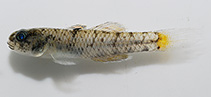
Espinas dorsales (total) : 7; Radios blandos dorsales (total) : 6 - 7; Espinas anales: 1; Radios blandos anales: 6 - 7. This species is distinguished by the following characters: D2 I,6-7 (usually 7); A I,6-7 (usually 7); pectoral-fin rays 13-16 rays; segmented caudal rays 15-16 in 8/7 or 9/7 pattern; lateral scales 23-27; transverse scale count 7-8; predorsal scales 6-7; opercle has 2-4 rows of cycloid scales; cheek scaleless; shoulder girdle with a smooth narrow flange or smooth edge; tongue is short and often blunt; males with teeth in outer row largest and widely spaced, slightly flattened and usually straight with pointed tips; females with outer row teeth very small, close-set, evenly sized and usually blunt-tipped. Colouration: head and body translucent to pale yellowish and with 5-6 diffuse greyish saddles on dorsum which may extend ventrally as indistinct bars and mid-side of body with five brownish blotches; scaly base of caudal fin with two blackish rounded spots, placed above and below last mid-lateral brownish spot and a broad half-moon shaped to vertical yellow bar extending from these dark spots onto caudal fin itself (Ref. 126575).
Cross section: compressed.
Facultative air-breathing in the genus (Ref. 126274); Occurs in shallow tidal pools of mangroves and muddy intertidal habitat (Ref. 94986). Often occurring with Pseudogobius poicilosoma, and sometimes with P. avicennia and P. verticalis (Ref. 126575).
Ciclo vital y comportamiento de apareamiento
Madurez | Reproducción | Puesta | Huevos | Fecundidad | Larva
Larson, H.K. and M.P. Hammer, 2021. A revision of the gobiid fish genus Pseudogobius (Teleostei, Gobiidae, Tridentigerinae), with description of seven new species from Australia and South-east Asia. Zootaxa 4961(1):1-85. (Ref. 126575)
Situación en la Lista Roja de la UICN (Ref. 130435: Version 2025-2 (Global))
Amenaza para el ser humano
Harmless
Usos humanos
Herramientas
Informes especiales
Descargar XML
Fuentes de Internet
Estimaciones basadas en modelos
Índice de diversidad filogenética (Referencia
82804): PD
50 = 0.5000 [Uniqueness, from 0.5 = low to 2.0 = high].
Bayesian length-weight: a=0.00708 (0.00332 - 0.01511), b=3.07 (2.89 - 3.25), in cm total length, based on LWR estimates for this (Sub)family-body shape (Ref.
93245).
Nivel trófico (Referencia
69278): 3.0 ±0.5 se; based on size and trophs of closest relatives
Resiliencia (Referencia
120179): Alto, población duplicada en un tiempo mínimo inferior a 15 meses (Preliminary K or Fecundity.).
Vulnerabilidad pesquera (Ref.
59153): Low vulnerability (10 of 100).
🛈