Classificação / Nomes
Nomes comuns | Sinônimos | Catalog of Fishes(Gênero, Espécies) | ITIS | CoL | WoRMS | Cloffa
>
Cichliformes (Cichlids, convict blennies) >
Cichlidae (Cichlids) > Pseudocrenilabrinae
Etymology: Petrochromis: Latin, petra = stone + Greek, chromis = a fish, perhaps a perch (Ref. 45335); horii: Named in honour of M. Hori of Kyoto University, Japan; he suggested that this fish might represent an undescribed species (Ref. 95531).
Eponymy: Professor Dr Michio Hori is a fish ecologist at Kyoto University, Japan. [...] (Ref. 128868), visit book page.
Meio ambiente: milieu / Zona climática / intervalo de profundidade / faixa de distribuição
Ecologia
; Água doce bentopelágico, usually 13 - 15 m (Ref. 95531). Tropical
Africa: Lake Tanganyika (Ref. 95531).
Tamanho / Peso / Idade
Maturidade: Lm ? range ? - ? cm
Max length : 10.4 cm SL macho/indeterminado; (Ref. 95531); 13.8 cm SL (female)
Descrição suscinta
Chaves de identificação | Morfologia | Morfometria
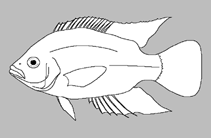
Espinhos dorsais (total) : 18 - 19; Raios dorsais (total) : 9 - 10; Espinhos anais: 3; Raios anais : 7 - 8. Diagnosis: Petrochromis horii differs from its congeners with no overlaps in several morphological characters: its body is deeper than that of Petrochromis macrognathus; the caudal peduncle is deeper than that of P. orthognathus; the pectoral fin is longer than that of P. macrognathus; the pelvic fin is longer than that of P. fasciolatus; the caudal fin is longer than that of P. famula, P. fasciolatus and P. orthognathus; the interorbital region is wider than that of P. macrognathus and P. orthognathus; the upper jaw protrudes more than that of P. fasciolatus and less than that of P. macrognathus, P. polyodon and P. trewavasae; the soft rays in the dorsal fin are fewer than in P. macrognathus; and the number of scales in longitudinal line is larger than in P. famula and P. orthognathus (Ref. 95531).
Body shape (shape guide): fusiform / normal.
Usually found on rocks (Ref. 95531).
Ciclo de vida ou comportamento de acasalamento
Maturidade | Reprodução | Desova | Ovos | Fecundidade | Larvas
Takahashi, T. and S. Koblmüller, 2014. A new species of Petrochromis (Perciformes: Cichlidae) from Lake Tanganyika. Ichthyol. Res. 61(3):252-264. (Ref. 95531)
Status na Lista Vermelha da UICN (Ref. 130435: Version 2025-2 (Global))
Ameaça para os humanos
Harmless
Uso pelos humanos
Ferramentas
Relatórios especiais
Baixar XML
Fontes da internet
Estimativas baseadas em modelos
Índice de diversidade filogenética (Ref.
82804): PD
50 = 0.5039 [Uniqueness, from 0.5 = low to 2.0 = high].
Bayesian length-weight: a=0.01905 (0.00846 - 0.04293), b=3.01 (2.82 - 3.20), in cm total length, based on LWR estimates for this (Sub)family-body shape (Ref.
93245).
Resiliência (Ref.
120179): Elevada, tempo mínimo de duplicação da população menor que 15 meses (Preliminary K or Fecundity.).
Vulnerabilidade da pesca (Ref.
59153): Low vulnerability (10 of 100).
🛈